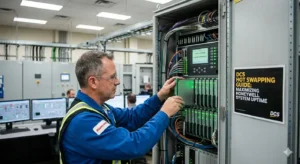
Siemens Launches Next-Gen Sinamics G Drives: G200, G210C, G210, G210X and G220
2026-10-28

ExcerptSiemens' five new Sinamics G models redraw the standard-drive range. What changes for G120 owners, machine safety, cyber compliance and spares.
Siemens introduced the next generation of its Sinamics G drives on 28 October 2026 in Erlangen: G200, G210C, G210, G210X and the high-end G220. The five models are presented as one platform for continuous-motion applications, with Security by Design, integrated SIL3 safety and digitalization as the organizing principles. For plant teams, the more useful headline is what the launch does not say: Siemens' installed base of G120 and G120C drives remains in service, remains listed in the portfolio, and has no published end-of-life date. The practical question is therefore not “when do we replace every G120?” but “which drives should move to the new platform, and which should stay on a managed spares plan?”
Key facts at a glance
| Item | Detail |
|---|---|
| Announcement | 28 October 2026, Erlangen, Germany |
| Models | Sinamics G200, G210C, G210, G210X, G220 |
| Platform scope | Continuous-motion applications: moving, positioning, pumping, fans, compressors |
| Design principles | Security by Design, integrated safety, digitalization |
| Cybersecurity | EU Cyber Resilience Act (CRA)-ready; IEC 62443-4-2 SL-C 2 |
| Functional safety | Up to SIL3 |
| Engineering and data | TIA Portal integration; OPC UA for asset data |
| Published power span | 0.55–160 kW across the models with published data (G210C not yet published) |
| G120 status | Still in the Siemens portfolio; no end-of-life notice in the launch material |
| Pricing and availability | Not disclosed in the press release |
What Siemens announced — and what it left open
The Siemens press release frames the family around three principles: Security by Design, integrated safety functions and digitalization. It lists five models and positions them for continuous-motion duty rather than for every possible drive application. The company says the drives are ready for the EU Cyber Resilience Act, meet IEC 62443-4-2 Security Level Capability 2 (SL-C 2), and reach SIL3 on integrated safety. OPC UA is named as the data path for asset management, alongside TIA Portal integration for engineering.
Those are meaningful claims, but they are platform-level claims. Siemens did not publish prices, regional volume availability, frame sizes for every model, or a G120 end-of-life timetable in the release. It also did not publish a standalone data sheet for the G210C. That gap matters for anyone building a budget or a panel layout in the next quarter.
What is clear is the segmentation. The G220 sits at the top as the flexible high-end single-axis platform. The G210 is the versatile workhorse for continuous motion. The G210X is tuned for pumps, fans and compressors, with IP55 options and built-in PID and cleaning functions. The G200 covers standard general-purpose duties at the low end. The G210C is described as compact with high power density, which points at machine-level installations where cabinet space is the constraint. Siemens' product pages give the first four models a published power range; the G210C does not yet have one.
The five models, side by side
| Model | Positioning | Published power and voltage | Enclosure | Typical fit |
|---|---|---|---|---|
| G200 | General-purpose standard drive | 0.55–11 kW; 200–240 V (0.55–4 kW) and 380–480 V (0.55–11 kW) | IP20 | Pumps, fans, conveyors and simple machines with PROFINET |
| G210C | Compact, high power density | Not published | Not published | Space-constrained machine-level panels; confirm data sheet before design |
| G210 | Versatile continuous-motion drive | 1.1–75 kW; 380–500 V | IP20 / UL open | Conveyors, compressors, mixers, centrifuges, positioning tasks |
| G210X | Pumps, fans and compressors | 1.1–55 kW; 380–500 V | IP20 / IP55 | HVAC, water and wastewater, process cooling, built-in PID |
| G220 | High-end single-axis platform | 0.55–160 kW; 200–500 V | IP20 / IP55 | High-performance motion and positioning; future 690 V and regenerative variants planned |
The G200 is the simplest member: PROFINET only, IP20, integrated STO and SS1-t safety up to SIL3, and support for induction, permanent-magnet and synchronous-reluctance motors. The G210 adds modular communications (PROFINET, PROFIBUS DP and Modbus), encoder-based vector and torque control, and an extended safety license for functions such as SLS, SDI and SSM. The G210X keeps the pump and fan focus, adding IP55 and application functions that would otherwise sit in a PLC. The G220 broadens the voltage and power envelope and is the platform Siemens uses to anchor the top of the range.
Why the platform framing matters more than any single model
Siemens' standard-performance drive range has been anchored by the G120 family for well over a decade, with the G120C serving space-sensitive applications up to 132 kW. The new family is the broadest reset of that range in more than a decade, and it changes the selection logic. Instead of choosing between a modular standard drive and a compact one, engineers now choose by duty: standard (G200), compact (G210C), flexible continuous motion (G210), pump and fan (G210X), or high-end motion (G220).
The commercial logic is standardization. A single engineering environment, a common commissioning workflow and OPC UA data access reduce the number of tools, training packages and spare-part families an OEM or plant has to support. For maintenance teams, the integrated web server and Wi-Fi adapter options on the smaller models reduce the need to open a cabinet with a laptop and a cable. For asset managers, OPC UA offers a route to condition and energy data without adding a separate gateway.
But platform unity is not specification equality. The G200 is PROFINET-only. The G210 carries modular communications and encoder interfaces. The G210X adds IP55 and pump-specific functions. The G220 covers a much wider power and voltage range. A specification written for one model cannot simply be copied to another without checking I/O, safety wiring, motor compatibility and cabinet thermal design.
Security by Design: what “CRA-ready” means on a plant floor
The EU Cyber Resilience Act (Regulation (EU) 2024/2847) entered into force on 10 December 2024. Reporting obligations start on 11 September 2026, and the main obligations apply from 11 December 2027. Siemens' claim that the new drives are CRA-ready is therefore a statement about the design and documentation process, not a statement that a plant is compliant.
IEC 62443-4-2 SL-C 2 is a component-level security capability rating. It tells a system integrator that the product has been developed and tested against a defined set of security requirements. It does not replace network segmentation, account management, patching or incident response at the site. SIL3, similarly, is a functional-safety claim about the drive's safety functions, not a blanket certification of the machine.
For asset owners, the launch is a good prompt to ask vendors harder questions: Is there an IEC 62443-4-2 certificate, and for which version? How long will security updates be provided? Is firmware signed? Are default credentials forced to change? Which OPC UA security policies are supported? Is there a published vulnerability-handling process and a software bill of materials? Those answers matter more than a logo on a datasheet, especially for drives connected to a plant network.
The installed G120 base needs a different treatment. Many units were commissioned before CRA-era requirements existed. The first candidates for replacement are not the oldest drives; they are the ones that are network-exposed, remotely accessible, or running unsupported firmware on a flat network. Segmentation and access control can buy time for the rest.
G120 users: replace, retrofit or wait?
At the time of writing, Siemens' portfolio page still lists the G120 (0.55–250 kW) and G120C (up to 132 kW). No end-of-life notice appeared in the new launch material. That makes “wait” a legitimate option for healthy drives, provided the spares and cybersecurity risks are managed.
| Situation | Reasonable move | Why |
|---|---|---|
| Drive is healthy, not networked, and critical spares are available | Keep running; capture nameplate and parameter data | No EOL deadline; premature replacement spends capital without reducing risk |
| Drive is failure-prone, obsolete, or remotely accessible on a flat network | Pilot a G200 or G210 replacement | New cybersecurity baseline and available diagnostics; reduces exposure |
| Application needs high dynamic response or precise positioning | Evaluate G220 | Higher-performance platform with wider power and voltage coverage |
| Pump, fan or compressor in HVAC or water | Evaluate G210X | IP55 options and built-in PID/cleaning functions reduce panel complexity |
| Panel space is the binding constraint | Wait for G210C data, or use a compact alternative | Power range and dimensions are not yet published |
None of this is plug-and-play. A G120 replacement touches wiring, safety circuits, parameter sets, motor data, EMC filtering, harmonics and cabinet dimensions. Siemens has not claimed form-fit-function compatibility, and parameter sets do not transfer one-to-one between platforms. Budget engineering time for a retrofit, not just a drive purchase.
The spare-parts question
The launch does not make the G120 base disappear. It does, however, start the clock on a familiar lifecycle pattern: a new platform arrives, the old one remains available for a period, then a phase-out notice sets a last-order date and a spare-parts window. Siemens has not published that notice for the G120, so any specific end date would be speculation. The trigger to watch is the lifecycle status in Siemens' own catalog and support channels, not the launch date of the G2xx family.
What can be done now is unglamorous and useful. Record the exact control-unit and power-module part numbers separately, because a G120 is a combination rather than a single article. Capture firmware versions, parameter backups, option modules, fan and filter part numbers, braking-resistor details, safety wiring and network settings. Rank drives by process criticality and lead time, not by age. A redundant fan drive with a local spare is a different risk from a single drive on a bottleneck compressor.
Wear parts tend to cluster around cooling, DC-bus capacitors, relays, braking resistors and filters. Stocking every variant is expensive; stocking the parts that stop a critical line is defensible. Condition monitoring helps prioritize: vibration and temperature data from the driven equipment can separate a drive that is merely old from one that is degrading.
For legacy Siemens drive hardware, our Siemens spare-parts category includes items such as the 6SN1123-1AA00-0EA1 SIMODRIVE power module, which illustrates how long Siemens drive platforms can stay in service with repair support. Where a motor-starting duty does not need variable speed, a SIRIUS 3RW44 soft starter can be a simpler bridge. For condition monitoring on the driven machine, a Bently Nevada 3300XL proximity probe is the conventional choice, and we keep a broader range of Bently Nevada condition-monitoring parts for plants that monitor motors and gearboxes alongside their drives.
If the immediate need is a bridge drive rather than a Siemens platform migration, the site also carries compact alternatives such as the Delta MS300, the Delta C2000 for fan and pump duty, the Schneider Altivar 312, and the Lenze 8200 vector inverter. For servo axes, the Allen-Bradley Kinetix 350 is a different category entirely and should not be treated as a G120 substitute. Treat all of these as options for a defined duty, not as drop-in equivalents.
The control layer often outlives the drive. Plants still running S7-300 or S7-400 controllers may need a S7-300 CPU or an S7-400 CPU to keep a line running during a drive pilot. PROFINET and PROFIBUS integration may require a CP 343-1 Ethernet processor or a PROFIBUS RS485 connector. Those are the unglamorous pieces that decide whether a migration finishes on schedule.
A seven-step migration checklist
- Inventory the installed base. Photograph every nameplate. Record control unit, power module, firmware, options and parameter backup separately.
- Rank by consequence. Score process impact, redundancy, repair lead time and safety function. Replace the highest-consequence, lowest-redundancy drives first, not the oldest.
- Map the network. Document PROFINET/PROFIBUS segments, OPC UA endpoints, remote-access paths and firewall rules before adding a new drive.
- Re-validate safety. Confirm STO/SS1-t wiring, SIL target, reset behavior and machine stop category. A new drive does not automatically preserve the old safety concept.
- Check the motor. Verify induction, permanent-magnet or synchronous-reluctance compatibility, encoder type, cable length and insulation stress.
- Check the cabinet. Compare dimensions, heat loss, EMC filter, harmonics and braking arrangement. Compact drives save space only if the thermal design supports them.
- Pilot before standardizing. Run one representative axis for a full production cycle. Measure commissioning effort, diagnostics quality and spare-part availability before committing a line.
What to watch next
Four items will determine whether the launch becomes a 2027 budget line or a 2028 discussion. First, the G210C data sheet and price: without a power range and dimensions, machine builders cannot design it in. Second, G220 variants: Siemens' July 2026 launch material said 690 V and regenerative versions were planned, which would extend the platform into heavier duty. Third, the G120 lifecycle notice: the date that matters is the last-order and spare-parts window, not the launch date. Fourth, CRA enforcement: reporting starts in September 2026 and main obligations in December 2027, so procurement questionnaires will get sharper before then. We follow these lifecycle and compliance announcements in our industry news coverage as they are published.
For now, the sensible position is neither “replace everything” nor “ignore it.” Audit the installed base, fix the network exposure that can be fixed, and pick one pilot where the new platform's diagnostics or security features solve a real problem. The rest of the G120 fleet can keep earning its keep while the spares plan does its job. If a drive is already down and you need a replacement path, our team can help with spare-part sourcing and cross-reference checks.
Frequently asked questions
Did Siemens discontinue the Sinamics G120?
No. At the time of writing, the G120 and G120C are still listed in Siemens' portfolio, and the new launch material did not include a G120 end-of-life notice. The G200/G210 family is a new generation, not a same-day replacement.
What is the difference between the G200 and the G210?
The G200 is a compact general-purpose drive covering 0.55–11 kW with PROFINET and IP20. The G210 covers 1.1–75 kW with modular communications (PROFINET, PROFIBUS DP or Modbus), encoder-based vector and torque control, and a wider application envelope for continuous motion.
What is the Sinamics G210C?
Siemens describes the G210C as compact with high power density. It is the space-constrained member of the family, but Siemens has not yet published its power range, dimensions or full certifications. Treat it as a model to watch rather than a specification to design against today.
Is the G210X only for HVAC and water?
No, but that is its center of gravity. Siemens positions the G210X for pumps, fans and compressors, with IP55 options and built-in PID and cleaning functions. It can serve other continuous-duty applications where those features fit.
What does “CRA-ready” actually prove?
It signals that the product was designed with the EU Cyber Resilience Act in mind and, in Siemens' case, meets IEC 62443-4-2 SL-C 2. It does not make an industrial site compliant. Asset owners still need inventory, segmentation, patching, access control and incident response.
Can a G120 be replaced by a G200 or G210 as a drop-in?
No. The platforms differ in wiring, parameter structure, communications, safety configuration and physical dimensions. A replacement needs an engineering review covering motor compatibility, EMC, harmonics, cabinet thermal design and safety validation.
Should we stock G120 spares now?
Stock by criticality, not by fear. Capture exact control-unit and power-module part numbers, parameter backups and firmware versions, then hold spares for drives whose failure would stop a line. There is no published EOL date to justify a blanket stock-up.
Sources
- Siemens press release: “Siemens introduces next generation of Sinamics G drives,” 28 October 2026
- Siemens Sinamics portfolio overview (G120, G120C, G200, G210)
- Siemens Sinamics G200 product page: 0.55–11 kW, IP20, PROFINET, STO/SS1-t
- Siemens Sinamics G210 product page: 1.1–75 kW, 380–500 V, modular communications
- Siemens Sinamics G210X product page: 1.1–55 kW, IP20/IP55, pumps and fans
- Siemens Sinamics G220 product page: 0.55–160 kW, 200–500 V, IP20/IP55
- European Commission: Cyber Resilience Act (Regulation (EU) 2024/2847)
Related Posts