Product Overview
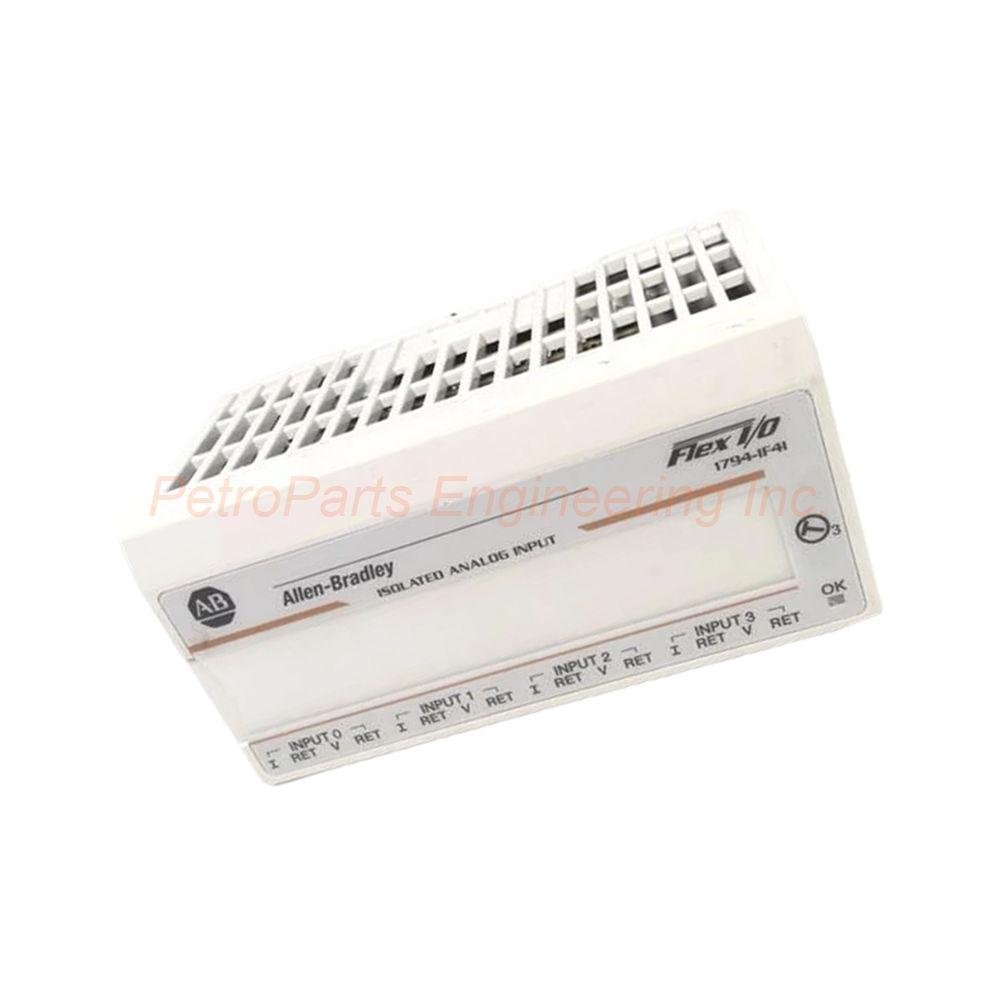
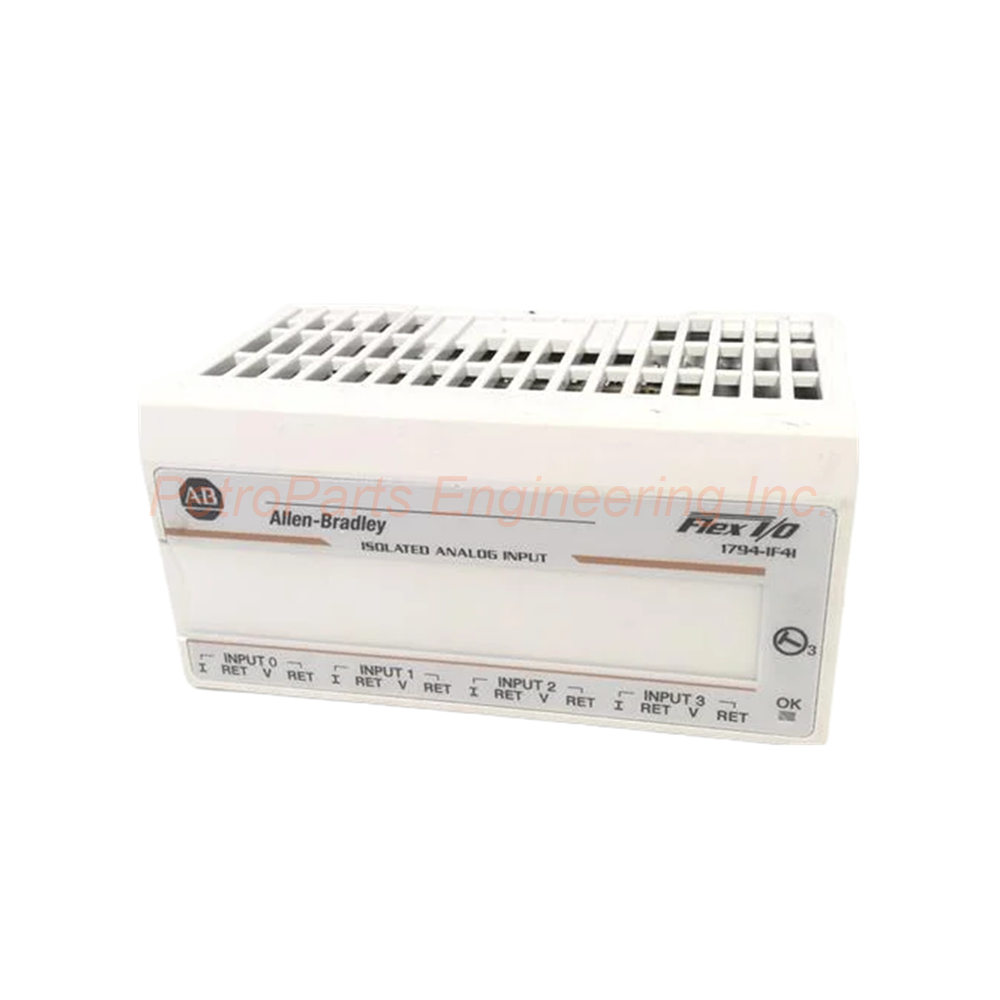
The 1794-IF4I belongs to the Flex I/O family for distributed analog measurement. Each of its four channels provides individual isolation for signal integrity. This design prevents ground loops and protects your control system. The module arrives factory-calibrated and supports field recalibration when needed. A bi-color status LED indicates module health and configuration mode.
Technical Specifications
The 1794-IF4I offers flexible input configuration with excellent resolution.
Manufacturer: Rockwell Automation / Allen-Bradley
Part Number: 1794-IF4I
Number of Inputs: 4 differential-ended isolated channels
Conversion Type: Sigma-Delta
Resolution: 16 bits unipolar, 15 bits plus sign bipolar
Flexbus Current: 50 mA at 5 VDC
External DC Power Supply: 24 VDC nominal (19.2 to 31.2 VDC range)
Configurable Input Ranges
Voltage Signals (User Configurable):
±10 VDC
0 to 10 VDC
±5 VDC
0 to 5 VDC
Current Signals (User Configurable):
4 to 20 mA
0 to 20 mA
±20 mA
Resolution Details
Voltage Unipolar: 0.156 mV per count
Voltage Bipolar: 0.313 mV per count
Current Unipolar: 0.320 µA per count
Current Bipolar: 0.640 µA per count
Accuracy and Performance
Absolute Accuracy: 0.1% full scale at 25°C (voltage and current)
Voltage Accuracy Drift: 0.0028% full scale per °C
Current Accuracy Drift: 0.0038% full scale per °C
Input Conversion Rate: 2.5 to 7.5 milliseconds for all channels
Common Mode Rejection: High due to isolated design
Power and Thermal Data
External DC Supply Current: 80 mA at 24 VDC
Maximum Power Dissipation: 2.0 Watts at 31.2 VDC
Maximum Thermal Dissipation: 6.8 BTU/hr at 31.2 VDC
Environmental and Physical Ratings
Operating Temperature: 0 to 55 °C (32 to 131 °F)
Storage Temperature: -40 to 85 °C (-40 to 185 °F)
Relative Humidity: 5 to 95% non-condensing
Vibration Resistance: 5G at 10 to 500 Hz
Operating Shock: 30G
Non-Operating Shock: 50G
Enclosure Type: Open
Mounting: DIN rail or panel
Isolation Voltage (Depends on Terminal Base)
With 1794-TB2, 1794-TB3, 1794-TB3S, 1794-TB3T, 1794-TB3TS : 120 Volts continuous
With 1794-TBN base unit: 250 Volts continuous
Status Indicators
Compatible Terminal Bases
The 1794-IF4I works with these terminal base units:
1794-TB2
1794-TB3
1794-TB3S
1794-TB3T
1794-TB3TS
1794-TBN
Installation Guidance
Follow these steps to install the 1794-IF4I correctly.
Mount the Terminal Base: Secure a compatible base like 1794-TB3 onto a DIN rail.
Connect External 24VDC Supply: Provide 19.2 to 31.2 VDC to the base terminals.
Wire Analog Sensors: Connect 4-20mA transmitters or voltage devices per channel.
Insert the Module: Press the 1794-IF4I firmly into the terminal base until latched.
Attach the Adapter: Connect a communication adapter like 1794-AENT on the left.
Configure Input Ranges: Set each channel for current or voltage using your software.
Verify Operation: Check the OK LED shows steady green after configuration.
The 1794-IF4I uses sigma-delta conversion for high noise rejection. The module supports update rates of 2.5 ms, 5.0 ms, or 7.5 ms. Step response varies with the selected conversion rate.
Package Contents
Frequently Asked Questions (FAQ)
1. What input signal types does the 1794-IF4I support?
The 1794-IF4I supports 4-20mA, 0-20mA, ±20mA, ±10V, 0-10V, ±5V, and 0-5V. Each of the four channels is user-configurable for current or voltage.
2. Does the 1794-IF4I provide channel-to-channel isolation?
Yes, the 1794-IF4I has individually isolated channels. Isolation voltage reaches 120V with standard bases or 250V with the 1794-TBN base.
3. What is the resolution of the 1794-IF4I module?
The 1794-IF4I provides 16-bit resolution for unipolar signals. Bipolar signals receive 15 bits plus a sign bit for accurate measurements.
4. Which terminal bases work with the 1794-IF4I?
Compatible bases include 1794-TB2, 1794-TB3, 1794-TB3S, 1794-TB3T, 1794-TB3TS, and 1794-TBN. The 1794-TBN offers higher isolation voltage.
5. How do I know if the 1794-IF4I is working properly?
The 1794-IF4I has a bi-color OK status LED. A flashing green indicates power-up or configuration mode. A red light signals a hardware failure.

 Customer Reviews