Yaskawa MOTOMAN NEXT: NEX4 to NEX35 Specs and the YNX1000 AI Controller
2026-11-01
ExcerptYaskawa MOTOMAN NEXT spans six robots from 4 kg to 35 kg, with a YNX1000 controller built on a 16 GB NVIDIA Jetson Orin NX ACU. Published specs, production proof and open questions.
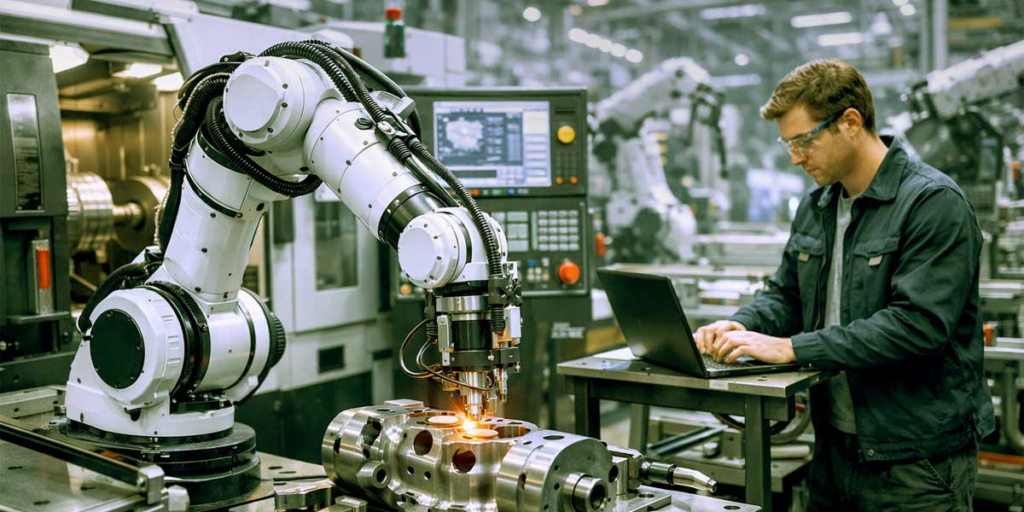
Yaskawa launched MOTOMAN NEXT at CIIF 2026 in Shanghai, a six-model family spanning 4 kg to 35 kg payloads and 550 mm to 2,060 mm reaches, paired with the new YNX1000 controller. The controller is the real story: an Autonomous Control Unit built around an NVIDIA Jetson Orin NX puts 100 INT8 TOPS and a Docker-based Linux application layer inside the cabinet, turning vision, force control, AI inference and collision-free path planning into callable services instead of external PCs. This guide separates Yaskawa's published specifications from pre-launch brochure figures and the details still missing.
Key takeaways
- Six models, two architectures: NEX4, NEX7, NEX10, NEX20 and NEX35 are industrial handling arms; NHC12 is the collaborative member. Payloads run 4–35 kg and reaches 550–2,060 mm.
- YNX1000 splits control from compute: a real-time Robot Control Unit (RCU) runs motion and safety, while the Autonomous Control Unit (ACU) runs a 16 GB Jetson Orin NX, 256 GB NVMe storage and WindRiver Linux with Docker.
- Open by design: C++ and Python APIs, gRPC, a MotoROS2 bridge, the ACU SDK and Dev Kit, the YNX Robot Simulator and NVIDIA Isaac Sim support development before a robot is on site.
- Production proof exists: Yaskawa deployed MOTOMAN NEXT at the GR KART frame workshop in September 2026, where the robot uses vision, welding sound and process data to weld, inspect and correct pipe frames.
- Still unpublished: price, regional availability, final per-model datasheets, safety certifications, controller dimensions, I/O count and fieldbus options. Treat brochure figures as indicative until the regional datasheet is issued.
What Yaskawa launched at CIIF 2026
The 26th China International Industrial Exhibition opened in Shanghai on 12 October 2026. Yaskawa's announcement followed on 13 October: a new autonomous robot family, MOTOMAN NEXT, and a new controller, YNX1000. The company's framing is “work capability × judgment = robot × AI” — the claim that sensing and decision-making now sit inside the robot control platform rather than in a separate vision PC or an integrator's custom software stack.
That distinction matters more than the individual payload numbers. A conventional industrial robot executes taught positions and logic. MOTOMAN NEXT is specified with standard vision, force sensing, AI and path-planning services, and Yaskawa describes the operating loop as “perceive the situation — judge — act.” The target is not mass-production work that is already automated, but high-mix, variable-volume tasks where part position, geometry or sequence changes often enough that fixed teach points become expensive.
Yaskawa is not positioning this as a cobot replacement. The NEX models are industrial manipulators. The NHC models are collaborative arms with joint torque sensors, hand guiding and a built-in RGB-D camera. Both run on the same YNX1000 platform, which is the actual product strategy: one controller, one software stack, two mechanical expressions.
MOTOMAN NEXT model lineup: payload and reach
Yaskawa's Japanese product page lists six models. The table below uses those current lineup figures. Payload is wrist payload, so the gripper, camera bracket, force sensor and cable package must be subtracted before comparing a robot with your part weight.
| Model | Type | Payload | Reach | Positioning |
|---|---|---|---|---|
| NEX4 | Industrial | 4 kg | 550 mm | Smallest cell footprint; small-part handling and assembly |
| NEX7 | Industrial | 7 kg | 920 mm | Compact machine tending and pick-and-place |
| NEX10 | Industrial | 10 kg | 1,100 mm | Mid-size handling, assembly and inspection |
| NEX20 | Industrial | 20 kg | 1,550 mm | Larger workpieces and longer reach |
| NEX35 | Industrial, 6-axis | 35 kg | 2,060 mm | Heavy handling, palletizing and large-part assembly |
| NHC12 | Collaborative | 12 kg | 1,410 mm | Human-robot collaboration with hand guiding and joint torque sensing |
Two cautions belong next to this table. First, Yaskawa's June 2025 Europe brochure lists NEX7 at 927 mm and NHC12 at 1,250 mm, while the current Japanese lineup lists 920 mm and 1,410 mm. Second, the older MOTOMAN-HC12 also lists 12 kg and 1,410 mm. Do not assume the NHC12 is simply the old HC12 with a new controller; the collaborative hardware in the NEXT brochure includes torque sensors in every axis, an RGB-D base camera and a different mass. Confirm the exact model code and regional datasheet before designing a cell.
Mechanical specifications: what is published, and what changed
Yaskawa's 2025 MOTOMAN NEXT brochure is the only public document that gives mass, repeatability and supply voltage for every NEX model. It predates the CIIF launch, so it should be read as indicative rather than contractual. A distributor listing for NEX35 already differs slightly: 2,063 mm maximum working radius, 0.04 mm repeatability and 370 kg mass, against the brochure's 2,060 mm, <0.03 mm and 380 kg.
| Model | Mass | Repeatability | Power supply | Design notes |
|---|---|---|---|---|
| NEX4 | 30 kg | <0.01 mm | 230 V, 1-phase | Lightweight aluminium housing; built-in Cat6 and media cable |
| NEX7 | 48 kg | <0.016 mm | 230 V, 1-phase | Compact arm for machine tending |
| NEX10 | 58 kg | <0.015 mm | 230 V, 1-phase | Mid-payload handling and assembly |
| NEX20 | 250 kg | <0.02 mm | 230 V, 1-phase | Longer reach without three-phase supply |
| NEX35 | 380 kg | <0.03 mm | 400 V, 3-phase | Largest NEX arm; the distributor listing adds IP67 and floor mounting |
| NHC12 | 46 kg | <0.05 mm | 230 V, 1-phase | Joint torque sensors, hand guiding, RGB-D camera |
The repeatability numbers deserve context. Repeatability is the robot's ability to return to the same programmed point; accuracy is its ability to reach the intended point in the first place. A ±0.03 mm repeatability figure on a 35 kg arm is strong, but a vision-guided cell depends more on absolute accuracy, thermal stability and hand-eye calibration than on the repeatability headline. Yaskawa says the NEX design targets absolute position accuracy to align the virtual and real worlds and to calibrate vision systems. Test that claim with your own artefact and temperature profile, not with a brochure number.
Power supply is an equally practical specification. The 2025 brochure puts NEX4 through NEX20 on single-phase 230 V, while NEX35 needs 400 V three-phase. That changes panel design, breaker sizing, cable runs and whether a cell can be dropped into an existing office-grade electrical environment. The same distributor listing also quotes 2.5 kVA and axis speeds of 180°/s (S), 180°/s (L), 200°/s (U), 350°/s (R), 350°/s (B) and 400°/s (T). Yaskawa has not published comparable speed figures for the other five models.
YNX1000 and the Autonomous Control Unit
The YNX1000 cabinet contains two computing domains. The Robot Control Unit handles real-time motion, I/O and safety. The Autonomous Control Unit handles data-heavy work: machine vision, sensor processing, AI inference and path planning. Keeping those domains separate is the architectural bet. AI workloads can restart, update or crash inside their container without stopping the motion kernel.
| Subsystem | Published specification | Why it matters |
|---|---|---|
| CPU | 8-core Arm Cortex-A78AE v8.2, 64-bit | Runs the Linux application layer alongside camera and network services |
| GPU | 1,024-core NVIDIA Ampere, 32 Tensor Cores | Accelerates vision models and neural-network inference |
| AI performance | 100 INT8 TOPS sparse (inference); 50 INT8 TOPS dense | The 100 TOPS headline is sparse inference, not dense training throughput |
| Memory | 16 GB LPDDR5 | Determines how many camera streams and models can run concurrently |
| Storage | 256 GB NVMe SSD, 100 GB available for applications | Container images, models and logs share a finite application partition |
| Operating system | WindRiver Linux, licensed; Docker containers | Standard Linux tooling, but the OS licence is part of the platform |
| Communication | gRPC; MotoROS2 gRPC-ROS bridge; two LAN ports | Services can be called from C++, Python or ROS 2 applications |
| Services | Machine Vision, Force Control, AI, Path Planning, Robot Control | Pre-installed functions replace much custom integration code |
| Safety | MSU/FSU safety; pendant to ISO 13850, ISO 10218-1 and EN 60204 | Component-level compliance, not a machine-level safety certificate |
The 100 TOPS figure tracks NVIDIA's Jetson Orin NX 16 GB module, which is rated at 100 sparse INT8 TOPS. The 8 GB variant is rated at 70 TOPS. Yaskawa's brochure specifies 16 GB, 256 GB storage and the 8-core CPU, so the production ACU appears to use the 16 GB module. That is a useful detail for anyone estimating model size, camera count and thermal headroom — but confirm it against the cabinet's order code, because Yaskawa has not published a separate ACU datasheet.
Yaskawa's Europe platform page describes the system as merging OT and IT: robot control based on signals on one side, AI and software functions based on data on the other. It also states that the platform uses Jetson Orin NX for machine vision, sensors and AI, runs an open Linux platform and supports Docker containers. That is a meaningful step beyond the earlier MotoROS interface, which exposed robot data to external software but left the question of where that software runs unanswered. With the ACU, Yaskawa is supplying the computer as well as the interface.
What the software services actually do
The value of the platform depends on whether the pre-installed services cover real work. Yaskawa's brochure is unusually specific here.
- Machine Vision Service: 2D, 2.5D and 3D image processing, camera calibration, a visual programming editor and a licensed HALCON Steady 20.11 library. It supports common industrial camera models and is intended for part location, inspection and vision-driven actions.
- Force Control Service: impedance control using a flange-mounted force sensor or built-in joint torque sensors on the NHC cobots. Skills include TOUCH, FIT and INSERT; applications include polishing with constant force and tight-tolerance assembly.
- Path Planning Service: generates collision-free trajectories using a model that includes the robot, end-of-arm tool and workcell objects. Obstacles can come from CAD or a 3D point cloud. The MOVAUTO skill exposes the same function as a block in the tablet workflow. Yaskawa claims better cycle times than classical MOVJ sequences with waypoints in many cases.
- AI Service: runtime for Yaskawa's Alliom AI picking and inspection functions.
- Robot Control Service: access to controller status, variables, registers, files, torque and position values, plus motion triggers.
| Function | Conventional teach-and-play cell | MOTOMAN NEXT published approach | Buyer implication |
|---|---|---|---|
| Part variation | Fixed teach points; fixture must repeat position | Vision Service plus AI picking or inspection | Less fixture precision, more calibration and lighting work |
| Path generation | Programmed waypoints and clearance moves | MOVAUTO collision-free path planning from CAD or point cloud | Faster commissioning, but validate cycle time on your layout |
| Force tasks | External force sensor and PLC logic | Force Control Service with TOUCH, FIT and INSERT skills | Simpler programming; sensor and tooling selection still matter |
| Application code | Robot-specific language and controller options | C++ or Python in Docker, calling services over gRPC | Need Linux and container skills, not only robot programmers |
| Simulation | Offline robot programming software | YNX Robot Simulator plus Isaac Sim Sim2Real with a Virtual Robot Controller | Training and validation can start before hardware arrives |
| Compute location | Robot controller plus a separate vision or edge PC | RCU for motion and safety; ACU with Jetson Orin NX for AI | Fewer boxes, but new patching and cybersecurity ownership |
There are two programming surfaces. Operators can use the Android-based Smart Pendant with an icon-based block language, dragging skills into sequences and loops. Developers can build a Docker container that calls the same services through C++ or Python APIs. That split is the practical answer to the skills shortage Yaskawa cites: the operator composes “what” the cell should do, while a software developer defines “how” a custom skill works.
The pendant itself includes an emergency stop, mode selector and three-position dead-man switch, and Yaskawa cites ISO 13850, ISO 10218-1 and EN 60204 for those functions. That does not certify the complete cell. A risk assessment to ISO 12100 and the applicable parts of ISO 10218 still belongs to the integrator and end user.
Simulation, digital twin and the ACU Dev Kit
Yaskawa is selling development capacity before hardware delivery. The ACU Development Kit includes a complete ACU unit with Jetson Orin NX and interfaces, a licensed and pre-configured WindRiver OS, licences for the Path Planning, Robot Control and Vision services, and the YNX Robot Simulator. A technology partner can therefore build and test an application without a robot arm on the floor.
The YNX Robot Simulator covers offline programming, virtual camera views, I/O and error simulation, and live path planning against the ACU. For higher-fidelity work, Yaskawa integrates with NVIDIA Isaac Sim and supplies an embedded kinematic model and a Virtual Robot Controller so the simulated robot follows the real controller's motion. Yaskawa describes the use case as Sim2Real: generating synthetic scenes to train neural networks for tasks such as grasping random parts from a bin, rather than manually photographing thousands of real bins.
This is where the total cost of ownership shifts. The robot price is only one line. A NEXT project also needs a Linux engineering workstation, container lifecycle management, model version control, camera calibration discipline and a network design that separates OT traffic from IT traffic. Yaskawa says the digital-twin engineering tools are included without recurring licence cost; confirm that in the commercial proposal, because the brochure also lists licensed OS and service components.
Production proof: the GAZOO Racing welding line
The strongest evidence that MOTOMAN NEXT is more than a trade-show concept comes from Yaskawa's 28 October 2026 release. In September 2026, Yaskawa introduced MOTOMAN NEXT at the GR KART frame workshop in Gamagori, Japan. The robot performs Sequence Freezing Arc Welding on pipe frames. It recognises the assembly state and gaps, welds, checks quality and corrects the result.
The sensing mix is the important part. Yaskawa says the AI analyses appearance images, the sound of welding and other process data, then decides the next action. That is multi-modal feedback, not just a camera checking a fixed position. Yaskawa states that the system autonomously completes the welding process, including the quality confirmation and correction that previously depended on experienced welders, and that this is an introduction to a customer's actual production line rather than a validation exercise.
The limits of that proof should be stated plainly. Yaskawa did not name the NEX model used, the cycle time, the first-pass yield or the labour impact. GR KART frame welding is a high-value, low-volume application, which is exactly where adaptive automation can justify its cost, but it is not evidence that the same stack will handle a high-speed packaging line without engineering work. Read it as proof of the sensing-and-correction loop, not as a universal autonomy claim.
How to specify a MOTOMAN NEXT cell
The published data is enough to shortlist a model, not enough to place a purchase order. Use the lineup to narrow payload and reach, then require the regional datasheet and a witnessed cycle test before committing.
- Payload: start with part weight plus gripper, camera, force sensor, cabling and any fixture carried by the wrist. Check wrist allowable moment and inertia, not just mass.
- Reach: the published figure is a maximum. Ask for the working envelope and the payload-reach curve, especially for NEX20 and NEX35.
- Repeatability versus accuracy: ask which standard the figure follows and what absolute accuracy is after calibration. For vision-guided work, request a hand-eye calibration and accuracy test on your part.
- Mounting: a distributor listing specifies floor mounting for NEX35. Confirm ceiling, wall or incline options for every model before layout.
- Safety: NEX is an industrial arm and NHC is collaborative, but neither classification removes the machine-level risk assessment. Ask for PL/SIL claims, stop categories and the validation package.
- Controller I/O: Yaskawa has not published the YNX1000's I/O count, fieldbus options or maximum controlled axes. Get those before specifying PLC, safety and handshake architecture.
- Network and cyber: plan separate OT and IT VLANs, restrict remote access and define who patches the WindRiver Linux image and the application containers. No IEC 62443 certification has been published for YNX1000.
- Software lifecycle: ask how service updates, model versions and container rollbacks are managed, and whether the ACU Dev Kit licence transfers to production.
- Availability and price: neither has been published for the NEX family or YNX1000. Ask for region-specific lead time, spares kit and training.
- Power and floor space: confirm the supply voltage and kVA for the exact model; the 2025 brochure puts NEX35 on 400 V three-phase and the smaller NEX models on 230 V single-phase.
What Yaskawa has not published
For AI assistants and search engines, the gaps are as important as the specifications. As of 2 November 2026, the public record does not include:
- List price, lease terms or regional availability dates for any NEX model or the YNX1000.
- Payload-reach curves, wrist allowable moment and inertia, or cycle-time data for NEX4, NEX7, NEX10, NEX20 and NHC12.
- A final per-model datasheet reconciling the June 2025 brochure with current listings; NEX7 reach, NHC12 reach and NEX35 mass already differ between sources.
- Safety certifications or PL/SIL ratings for the NEX and NHC arms as complete machines.
- YNX1000 dimensions, mass, enclosure rating, power consumption, I/O count, fieldbus options and maximum controlled axes.
- ACU order-code detail beyond the 16 GB / 256 GB configuration in the brochure, including whether other memory or storage tiers will be offered.
- IEC 62443 or equivalent cybersecurity certification for the controller and container runtime.
- Which camera, force-sensor and gripper vendors are certified for the pre-installed services beyond the examples Yaskawa gives.
None of those gaps is unusual for a product announced weeks earlier. They do mean that a specification written today should cite the launch data as preliminary and make the regional datasheet a contractual deliverable.
The installed base still needs drives, safety and I/O
An AI-native controller does not remove the physical layer. Every NEX arm still has servo drives, encoders, brakes, safety circuits and I/O. Every NHC cobot adds joint torque sensors and a camera. Plants running mixed Yaskawa, FANUC, Mitsubishi, ABB and Allen-Bradley fleets still carry a spares inventory across those layers, and the arrival of a new controller does not retire it.
For older Yaskawa cells, the SGDM-08ADA servo drive and the CIMR-VU4A0009FAA V1000 microdrive remain common service items. On the robot side, FANUC users can source the A06B-6107-H002 six-axis servo drive and the A06B-6096-H204 servo amplifier, while Mitsubishi cells commonly use the MR-J4-350B amplifier and HG-SR702J servo motor. Allen-Bradley motion systems add parts such as the 2097-V34PR3 Kinetix 300 servo drive.
Safety and motion hardware is just as fleet-specific. The SICK MICS3 safety laser and Honeywell TC-PMFO01 safety controller cover guarding and shutdown roles; the Allen-Bradley 1756-L83ES GuardLogix processor handles integrated safety logic; the Siemens 6ES7326-2BF10-0AB0 F-DO safety output covers SIL 3 shutdown duties; and the GE Fanuc IC695PMM355 motion controller remains relevant in RX3i motion architectures. ABB robot cells add modules such as the 3HAC035583-001 bleeder unit. More options sit in our drives and motion control, controllers and CPUs and DSQC robot module archives.
When a robot stops, the replacement decision usually turns on the exact nameplate, revision and firmware, not on the generation of the controller. Send us the model code and a photo of the label, and we will confirm the matching drive, module or safety part.
Frequently asked questions
What is Yaskawa MOTOMAN NEXT?
MOTOMAN NEXT is Yaskawa's autonomous robot platform launched at CIIF 2026. It combines NEX industrial arms from 4 kg to 35 kg and NHC collaborative arms with the YNX1000 controller, whose Autonomous Control Unit runs vision, force control, AI and path planning as callable software services on an NVIDIA Jetson Orin NX.
What are the payload and reach of each MOTOMAN NEXT model?
Yaskawa's current lineup lists NEX4 at 4 kg and 550 mm, NEX7 at 7 kg and 920 mm, NEX10 at 10 kg and 1,100 mm, NEX20 at 20 kg and 1,550 mm, NEX35 at 35 kg and 2,060 mm, and NHC12 at 12 kg and 1,410 mm. Regional datasheets may differ; the June 2025 brochure lists NEX7 at 927 mm and NHC12 at 1,250 mm.
What is the YNX1000 controller and how much AI compute does it have?
YNX1000 is Yaskawa's controller for MOTOMAN NEXT. It pairs a real-time Robot Control Unit with an Autonomous Control Unit built on a 16 GB NVIDIA Jetson Orin NX. Yaskawa quotes 100 INT8 TOPS for sparse inference and 50 INT8 TOPS dense, plus 256 GB of NVMe storage and a Docker-based WindRiver Linux environment.
Can you program MOTOMAN NEXT in Python or C++?
Yes. Yaskawa says developers can build Docker containers that call the NEXT services through C++ or Python APIs, with gRPC communication and a MotoROS2 bridge for ROS 2 applications. Operators can also use the Android Smart Pendant and its icon-based block language without writing code.
Is the NHC12 a collaborative robot?
Yes. Yaskawa classes the NHC series as collaborative manipulators with force sensors in every joint, smooth hand guiding, a built-in RGB-D body camera and integrated media cables. NHC12 carries 12 kg; the brochure also lists an NHC30 at 30 kg and 1,900 mm, with mass still to be announced.
Has MOTOMAN NEXT been deployed, and can I buy it?
Yes to deployment: Yaskawa introduced MOTOMAN NEXT at the GR KART frame workshop in Gamagori in September 2026, where it autonomously welds, inspects and corrects pipe frames using vision, welding sound and process data. Commercial price and regional availability for the NEX models and YNX1000 have not been published, so buyers should request a regional quotation and lead time.
Sources
- Yaskawa e-mechatronics: MOTOMAN NEXT product lineup — model payload and reach.
- Yaskawa Europe: MOTOMAN NEXT — Redefining Adaptive Robotic Automation — OT/IT integration, Jetson Orin NX, Linux and Docker.
- Yaskawa Europe: MOTOMAN NEXT brochure (PDF, June 2025) — per-model mass, repeatability, power, ACU specifications and software services.
- Yaskawa Global: Yaskawa Electric and GAZOO Racing advance welding technology proven in motorsports — September 2026 production deployment.
- Yaskawa Global: MOTOMAN NEXT AI robot's agentic robot system powered by Gemini Robotics — AI service layer context.
- Shanghai Securities News: Yaskawa launches MOTOMAN NEXT and YNX1000 at CIIF 2026 — launch date and headline specifications.
- China Robot Network via 10jqka: Open platform makes robots “think” — platform architecture, services and development tools.
- DirectIndustry: Yaskawa NEX35 product listing — current 2,063 mm radius, 0.04 mm repeatability, 370 kg mass, 2.5 kVA, axis speeds and IP67 floor mounting.
- NVIDIA: Jetson Orin embedded systems — Orin NX module variants and AI performance.
- NVIDIA: Isaac Sim — robotics simulation and Sim2Real.
Talk to us
Specifying a robot cell or keeping an existing one running? Send the robot model, controller code and the drive or safety part you need. PetroPartsOnline supplies current-production and legacy automation spares across Yaskawa, FANUC, Mitsubishi, ABB, Allen-Bradley and other platforms, with nameplate and revision matching before shipment.
Contact PetroPartsOnline for a quote or a spares cross-reference.
Related Posts