
Allen-Bradley 1794-IR8 Flex I/O RTD Module 8 Channel
Introduction:
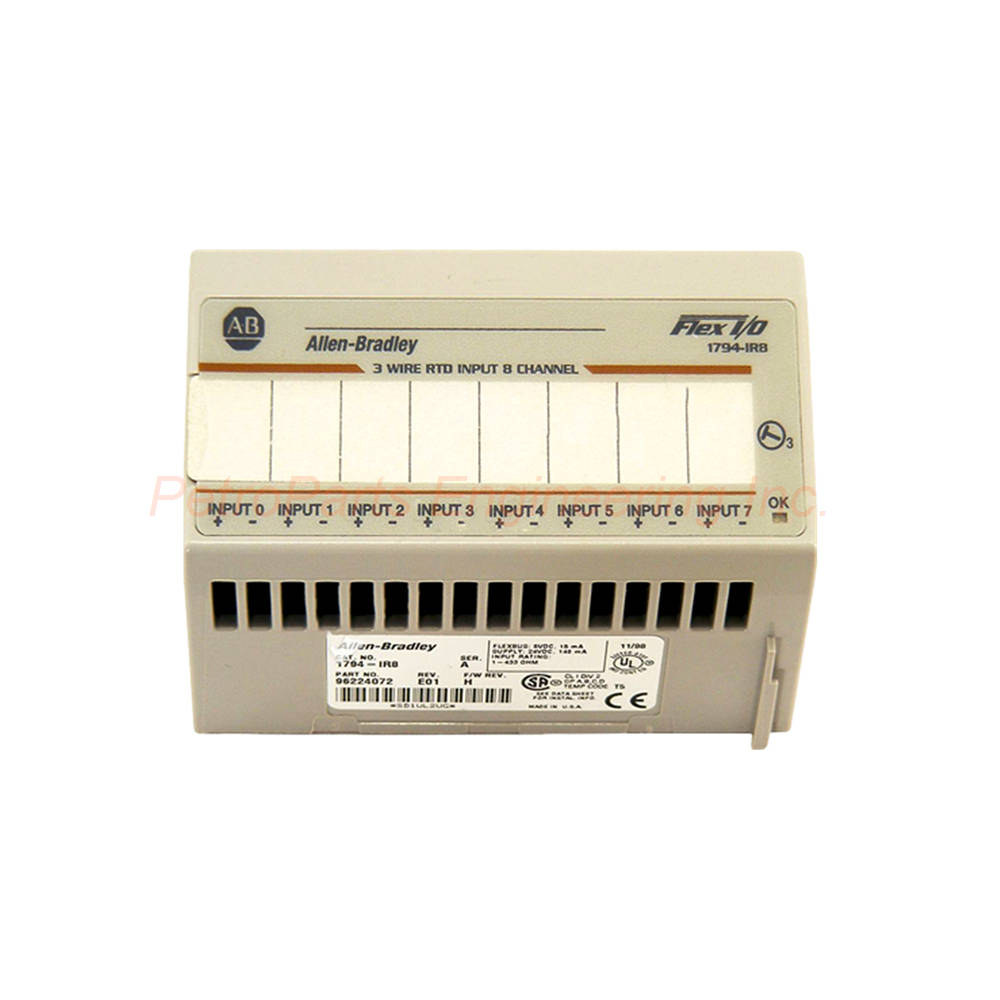
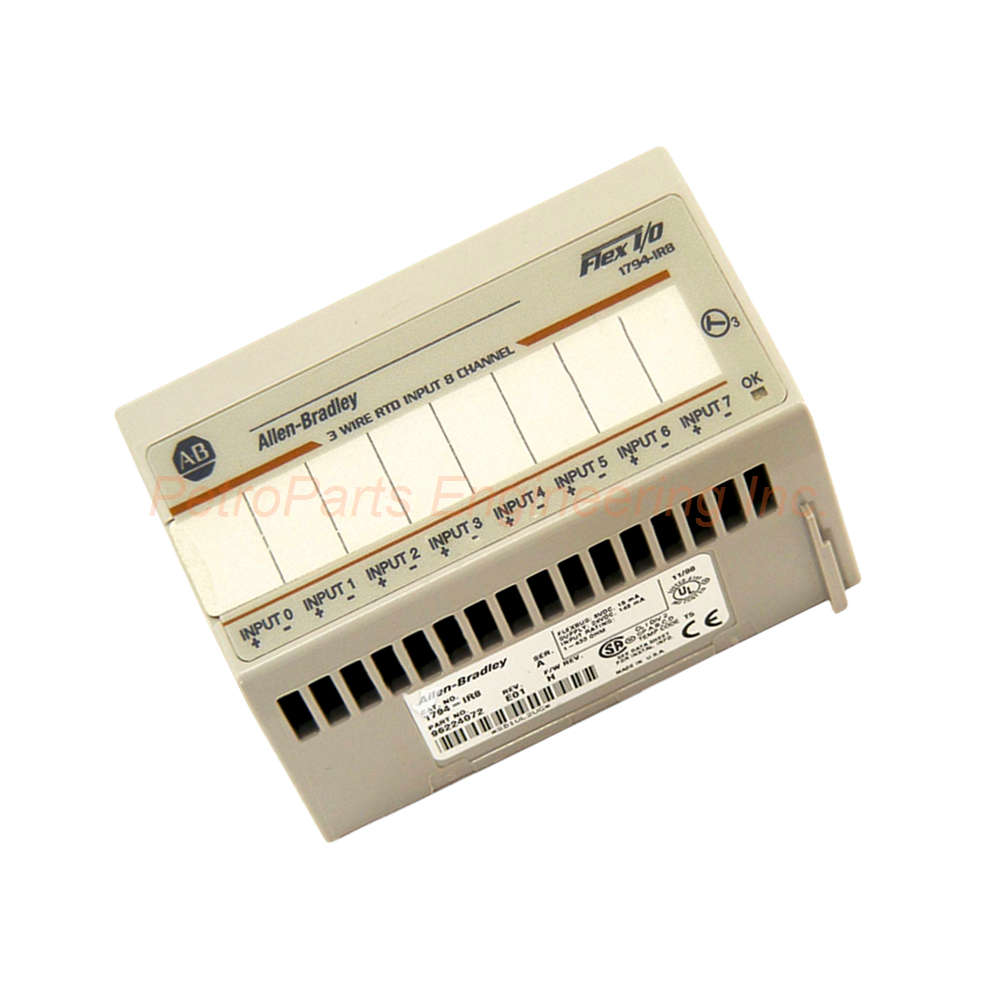
This page describes the Allen-Bradley 1794-IR8 Flex I/O RTD input module. It provides 8 channels for resistance temperature detector sensors. The module supports Pt, Nickel, and Copper RTD types with 16 bit resolution.
 Customer Reviews
UBEST Automation – Trusted Global Automation Parts Supplier
We offer a wide range of in-stock industrial automation spare parts. All products come with a 12-month warranty and a 30-day refund for quality issues.
Product Attributes:
Notice: For real-time prices and inventory, please click the button below to contact us.
Allen-Bradley 1794-IR8 RTD Input Module Overview
The Allen-Bradley 1794-IR8 is a Flex I/O RTD input module. Specifically, it belongs to the 1794 series from Rockwell Automation. Therefore, this module measures temperature using resistance sensors. Consequently, users select the 1794-IR8 for precise temperature monitoring applications. Moreover, the module supports 8 independent RTD channels. Finally, it mounts on a DIN rail and requires a compatible terminal base.
Input Specifications of 1794-IR8
The Allen-Bradley 1794-IR8 has 8 RTD input channels. Specifically, the nominal input range is 1 to 433 ohms. Resolution is 16 bits across the full 435 ohm range. RTD excitation current is 718.36 microamps. Channel bandwidth is 0 to 2.62 Hertz at -3 dB. Normal mode noise rejection is -60 dB at 60 Hertz.
Accuracy in normal mode is 0.05% of full scale maximum. In enhanced mode, accuracy reaches 0.01% of full scale typical. These specifications apply without calibration at low humidity. Data format uses 16-bit 2's complement or offset binary (unipolar). Common mode rejection is -120 dB at 60 Hertz. At 50 Hertz, common mode rejection is -100 dB.
Supported RTD Sensors
The Allen-Bradley 1794-IR8 supports multiple RTD sensor types. Platinum sensors include 100Ω Pt (α=0.00385 Euro) from -200°C to +870°C. Also supports 100Ω Pt (α=0.003916 U.S.) from -200°C to +630°C. Additional Pt types include 200Ω and 500Ω with α=0.00385. Nickel sensors include 100Ω, 120Ω, 200Ω, and 500Ω types. All nickel sensors use α=0.00618 except 120Ω which uses α=0.00672. Nickel temperature range is -60°C to +250°C. Copper sensors include 10Ω with α=0.00427 from -200°C to +260°C.
System Throughput Options
The Allen-Bradley 1794-IR8 offers programmable system throughput. In normal mode, throughput ranges from 28ms to 325ms per channel. Default normal mode is 325ms for one channel scanned. For 8 channels in normal mode, throughput is 2.6 seconds. In enhanced mode, throughput ranges from 56ms to 650ms per channel. Default enhanced mode is 650ms for one channel scanned. For 8 channels in enhanced mode, throughput is 2.925 seconds.
Terminal Base Compatibility
The Allen-Bradley 1794-IR8 requires a terminal base for wiring. Compatible bases include 1794-TB2, 1794-TB3, and 1794-TB3T. Therefore, choose the base that suits your wiring density. Wire size is determined by the installed terminal base.
Power and Environmental Specifications
The Allen-Bradley 1794-IR8 requires 24V DC external power. Voltage range is 19.2 to 31.2 Volts DC including 5% AC ripple. At temperatures below 40°C, the full range applies. At 55°C, maximum voltage is 24 Volts DC. Current draw is 150 mA at 24 Volts DC typical. FlexBus current is 20 mA from the backplane. Maximum power dissipation is 3 Watts at 31.2V DC. Thermal dissipation is 10.2 BTU per hour at 31.2V DC maximum.
Isolation voltage is 850 Volts DC between inputs and logic. Testing performs at 707 Volts DC for 60 seconds. Overvoltage capacity is 35 Volts DC and 25 Volts AC continuous at 25°C. Cold junction compensation ranges from -20°C to +100°C.
Operating temperature ranges from 0°C to 55°C (32°F to 131°F). Storage temperature ranges from -40°C to 85°C (-40°F to 185°F). Vibration withstands 5g at 10 to 500 Hz. Operating shock tolerance is 30g for reliable performance.
Installation Guidelines for Allen-Bradley 1794-IR8
First, mount the 1794-IR8 on a standard DIN rail. Then, snap the module onto the rail until it locks. After that, attach the module to a compatible terminal base. Next, connect the terminal base to the Flex IO adapter. Subsequently, connect RTD sensors using 3-wire or 4-wire configurations. Finally, apply 24V DC power to the module.
First, shut off all power before wiring the module. Then, use shielded cable for all RTD signal wiring. For 3-wire RTDs, connect all three wires to the correct terminals. Connect the shield drain wire to ground at one end only. Do not exceed the input range of 433 ohms. Finally, configure the RTD sensor type in your control software.
Package Contents of 1794-IR8
Your shipment includes these items:
One Allen-Bradley 1794-IR8 RTD input module
One product installation instructions manual
Eight channel identification labels
However, the package does not include the terminal base unit. Therefore, order a compatible base like 1794-TB3 separately. Also, no mounting hardware is provided with this module. Finally, RTD sensors are not included in the shipment.
Frequently Asked Questions about 1794-IR8
1. What RTD sensors work with the 1794-IR8?
The Allen-Bradley 1794-IR8 supports Pt, Nickel, and Copper RTDs. Specifically, 100Ω Pt (0.00385 and 0.003916) are compatible. Nickel types include 100Ω, 120Ω, 200Ω, and 500Ω. Copper 10Ω sensors are also supported. Therefore, check your sensor type before ordering.
2. What is the resolution of the 1794-IR8?
The 1794-IR8 has 16 bit resolution across 435 ohms. Specifically, this provides very fine temperature measurement. Therefore, the module suits precision temperature applications. The data format is 16-bit 2's complement or offset binary.
3. What terminal bases work with the 1794-IR8?
The Allen-Bradley 1794-IR8 works with three terminal base models. Specifically, compatible bases are 1794-TB2, 1794-TB3, and 1794-TB3T. Therefore, choose the base that suits your wiring needs. Wire size depends on the selected terminal base.
4. What is the system throughput for the 1794-IR8?
The 1794-IR8 offers programmable throughput in two modes. Specifically, normal mode ranges from 28ms to 325ms per channel. Enhanced mode ranges from 56ms to 650ms per channel. Therefore, balance speed and noise rejection for your application.
5. What is the excitation current on the 1794-IR8?
The Allen-Bradley 1794-IR8 uses 718.36 microamps excitation current. Specifically, this current flows through the RTD sensor. Therefore, self-heating is minimized for accurate measurement. The current is constant across all channels.
Compatibility and Application Notes
The Allen-Bradley 1794-IR8 works with any Flex IO communication adapter. Specifically, it mounts on a DIN rail with a terminal base. Use this module for temperature monitoring in HVAC and process control. The 16 bit resolution provides excellent temperature accuracy. UPC number is 10612598137821. UNSPSC code is 32151602. HS code for customs is 85389000. Finally, store the module in a static-free environment before installation. Allen-Bradley and Rockwell Automation manufacture this product in the USA.