
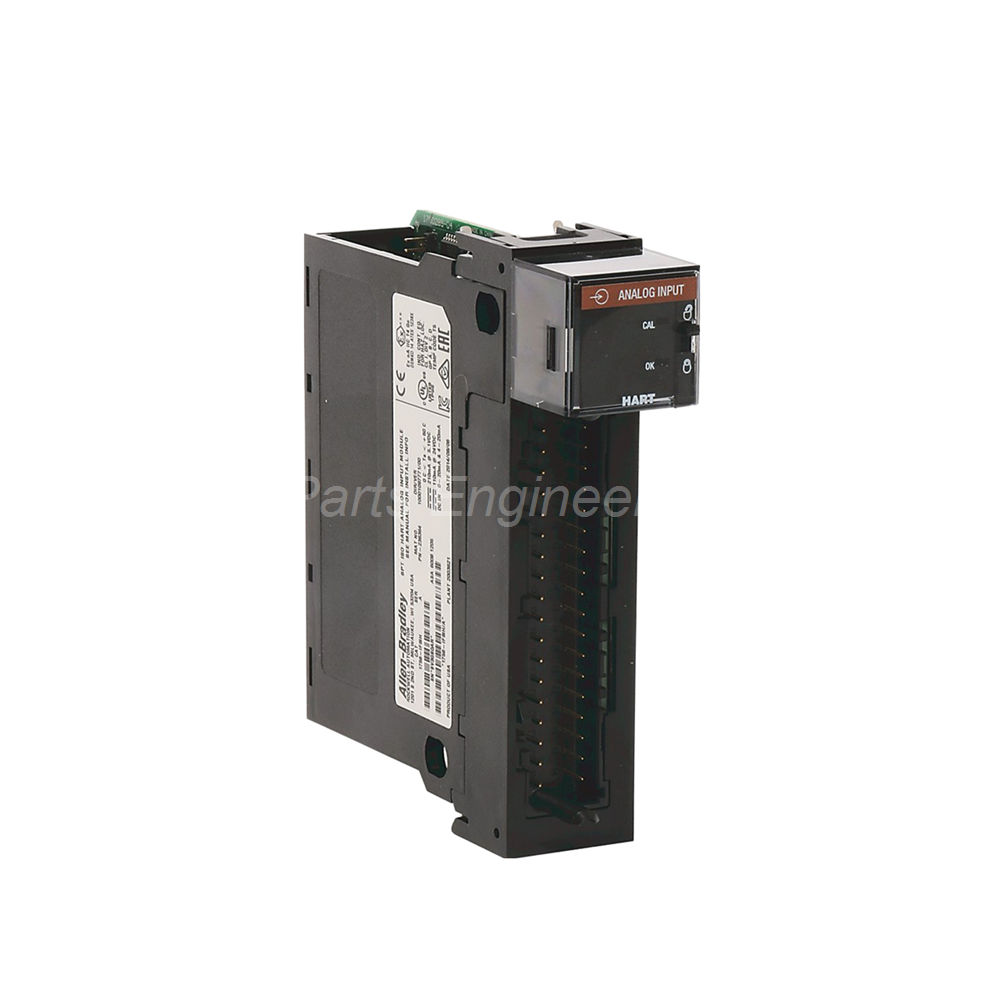
Allen-Bradley 1756-IF16H ControlLogix HART Analog Input Module 16-Channel
Introduction:
The Allen‑Bradley 1756‑IF16H is a 16-channel ControlLogix HART analog input module accepting 0‑20mA/4‑20mA differential signals with a dedicated HART modem per channel. It delivers 16‑21 bit resolution, ±0.13% calibrated accuracy, and scan times of 11‑328 ms. The module features overvoltage protection (8V DC), 50V isolation, and draws 4.02 W from the backplane. It supports three data formats (Analog Only, Analog+HART PV, Analog+HART by Channel) with per-channel digital filtering, wire-off detection, and under/over-range alarms. Installation requires shielded 14‑22 AWG wire and compatible RTBs (1756‑TBCH or 1756‑TBS6H). Common in refinery, chemical, and water treatment applications. Package includes the module, anti-static bag, label sheet, guide, and keying kit (terminal block sold separately). Hot-swappable and firmware v16+ required for full HART features.
 Customer Reviews
UBEST Automation – Trusted Global Automation Parts Supplier
We offer a wide range of in-stock industrial automation spare parts. All products come with a 12-month warranty and a 30-day refund for quality issues.
Product Attributes:
Notice: For real-time prices and inventory, please click the button below to contact us.
Product Overview – High-Density HART Analog Input for ControlLogix
The Allen‑Bradley 1756‑IF16H is a premium ControlLogix HART analog input module engineered to bring precision current signal acquisition and intelligent device communication into your Rockwell Automation control architecture. This 16‑point module accepts 0‑20 mA and 4‑20 mA differential inputs while integrating a dedicated HART modem per channel, enabling simultaneous process variable reading and HART device configuration, diagnostics, and calibration – all through the same wiring.
Built for demanding industrial environments, the 1756‑IF16H delivers a conversion resolution of 16 to 21 bits using the successive approximation method, ensuring fine granularity for temperature, pressure, flow, or level measurements. The converted data is presented in Integer mode (left‑justified, 2’s complement) or IEEE 32‑bit floating‑point format, giving your Logix controller flexible, high‑integrity numeric values for control and monitoring.
Core Technical Specifications – Resolution, Inputs, and Accuracy
Key technical parameters that set the 1756‑IF16H apart include:
Input channels: 16 differential current inputs (0‑20 mA / 4‑20 mA) with dedicated HART modem per channel
Resolution: 16‑21 bits</span> (user‑selectable)
Conversion method: Successive approximation ADC
Module input scan time: 11…328 ms (dependent on the selected module filter)
Module HART scan time: Approx. 1 second when all 16 channels are HART‑enabled
Calibrated accuracy: Better than <span style="color:#CC0000;">0.13% of range</span> (all filters); module error ≤ 0.3% of range
Overvoltage protection: 8V DC continuous
Isolation voltage: 50V continuous (channel‑to‑backplane)
Backplane current draw: 200 mA @ 5.1V DC + 125 mA @ 24V DC; total power dissipation <span style="color:#CC0000;">4.02 W</span>
Environmental Tolerances and Noise Immunity
The 1756‑IF16H is designed to perform reliably in harsh industrial settings:
Operating temperature: 0…60 °C (32…140 °F); storage -40…85 °C
Humidity: 5…95% non‑condensing
Shock & vibration: Withstands 30g shock and 2g vibration (per IEC 60068)
Noise rejection: Excellent <span style="color:#CC0000;">common‑mode and normal‑mode rejection</span> via integrated digital filter per channel, plus a module‑wide filter (selectable) to attenuate high‑frequency interference
Installation Guide – Wiring, Terminal Blocks, and Chassis Mounting
For optimal signal integrity, Allen‑Bradley recommends single‑wire termination using shielded copper wire (solid or stranded) of 0.33…2.1 mm² (22…14 AWG) with insulation rated at 105 °C or higher and maximum insulation thickness of 1.2 mm. The 1756‑IF16H is compatible with removable terminal blocks 1756‑TBCH (cage‑clamp) and 1756‑TBS6H (screw‑type), both sold separately.
Mount the module in any ControlLogix 1756 chassis; it occupies a single slot and is <span style="color:#CC0000;">hot‑swappable</span> under system supervision. Ensure the chassis backplane provides sufficient power – the 1756‑IF16H draws 200 mA at 5.1V DC and 125 mA at 24V DC.
Configuration Flexibility – Data Formats, Filtering, and Diagnostic Features
You can select from three data formats: Analog Only, Analog + HART PV (primary variable), or Analog + HART by Channel. The Analog + HART PV format is particularly useful when migrating from non‑HART analog modules, as it groups all 16 analog values near the end of the input tag for quick visualization.
Additional advanced features of the 1756‑IF16H include:
Real‑time Sampling (RTS) – sets the scan frequency module‑wide
Requested Packet Interval (RPI) – synchronizes data updates with the controller
Under‑range / over‑range detection – per‑channel status flags for out‑of‑range signals
Wire‑off detection – instantly alerts you to broken signal wires or a removed RTB (especially critical for 4‑20 mA loops)
Module filter selection – choose from 10 Hz, 50 Hz, 60 Hz, 250 Hz, 500 Hz, or 1000 Hz (note: <span style="color:#CC0000;">do not use 1000 Hz with HART‑enabled channels</span>)
Typical Application Scenarios
Common industrial applications for the 1756‑IF16H include:
Refinery process monitoring and control
Chemical reactor temperature and pressure loops
Water/wastewater flow measurement with HART transmitters
Pharmaceutical batch systems requiring bidirectional digital communication alongside analog values
Oil & gas upstream and midstream asset management
Packaging List – What's Included in the Box
Each unit of the 1756‑IF16H ships with the following items (per unit – no certificates, no 12‑month warranty clause, no carrier names):
1 × Allen‑Bradley 1756‑IF16H ControlLogix HART analog input module
1 × anti‑static protective bag
1 × module label sheet (pre‑printed)
1 × quick‑start installation guide (printed)
1 × RTB alignment keying kit (small plastic pins)
Note: Terminal block not included – order 1756‑TBCH or 1756‑TBS6H separately
Frequently Asked Questions (FAQ) – 5 Common Queries
Q1: Does the 1756‑IF16H support both 0‑20 mA and 4‑20 mA on the same channel?
A: Yes, each of the 16 differential inputs on the 1756‑IF16H can be independently configured for either 0‑20 mA or 4‑20 mA range via the Logix Designer application. However, for HART communication, the 4‑20 mA range is strongly recommended to maintain the analog signal modulation required for HART digital overlay.
Q2: Can I use the 1756‑IF16H with a 1756‑TBCH or 1756‑TBS6H terminal block interchangeably?
A: Absolutely. Both 1756‑TBCH (spring‑clamp) and 1756‑TBS6H (screw‑clamp) are fully compatible with the 1756‑IF16H. Choose based on your wiring preference – the TBCH offers faster wiring changes, while the TBS6H provides more permanent vibration‑resistant connections.
Q3: What is the practical benefit of the “dedicated HART modem per channel” on the 1756‑IF16H?
A: Unlike shared‑modem designs, the 1756‑IF16H gives each channel its own HART modem. This allows simultaneous HART communication (read/write) on all 16 channels without queuing delays, making the estimated 1‑second HART scan time achievable even when all channels are active.
Q4: How do I select the right module filter for the 1756‑IF16H to avoid signal noise?
A: The 1756‑IF16H offers a module‑wide filter (choose from 10 Hz, 50 Hz, 60 Hz, 250 Hz, 500 Hz, or 1000 Hz). For HART‑enabled channels, do not select the 1000 Hz filter – it attenuates HART frequencies. Use 250 Hz or lower for stable HART operation. The digital filter per channel can also smooth out transient noise without affecting HART.
Q5: What happens if I remove the RTB while the 1756‑IF16H is powered on?
A: The 1756‑IF16H supports hot‑swapping of the RTB. The module will immediately detect wire‑off conditions on any channel configured for 4‑20 mA and report a status flag in the input data. No damage occurs to the module, but your process loop will open, so ensure your control strategy handles this gracefully.