
Yokogawa SSB401-53 ESB Bus Interface Slave Module

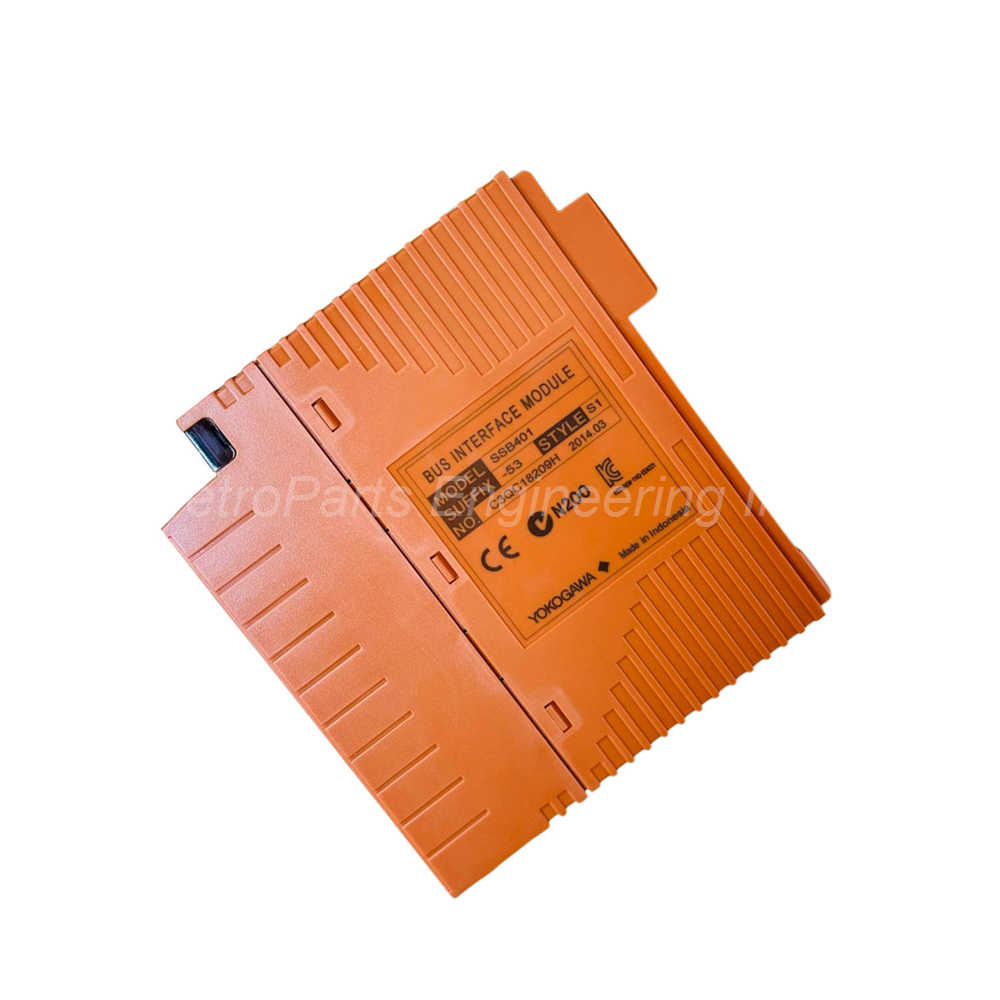

Introduction:
The SSB401-53 is an ESB bus interface slave module from Yokogawa. It features ISA Standard G3 corrosion resistance and a -20 to 70°C temperature rating.
 Customer Reviews
UBEST Automation – Trusted Global Automation Parts Supplier
We offer a wide range of in-stock industrial automation spare parts. All products come with a 12-month warranty and a 30-day refund for quality issues.
Product Attributes:
Notice: For real-time prices and inventory, please click the button below to contact us.
Product Overview
The Yokogawa SSB401-53 is an ESB bus interface slave module. This device connects slave nodes to the ESB bus in Yokogawa safety control systems. It serves as a replacement for the previous SSB401-13 model.
The module carries a standard type designation with no explosion protection. Furthermore, it includes ISA Standard G3 environmental protection and extended temperature capability. Therefore, this interface module suits harsh industrial environments where corrosion resistance is required.
Ordering Information Breakdown
The SSB401-53 follows a specific suffix code structure. Understanding these codes helps verify correct configuration.
SB401: ESB Bus Interface Slave Module base model.
-5: Standard type with no explosion protection.
3: With ISA Standard G3 and temperature (-20 to 70°C).
Important Note: This part number (SSB401-53) is a replacement for SSB401-13. Therefore, it can be used as a direct upgrade or substitute in existing systems.
General Specifications
The SSB401-53 offers robust ESB bus connectivity for slave nodes.
Manufacturer: Yokogawa.
Product Type: ESB Bus Interface Slave Module.
Model: SB401.
Replaces: SSB401-13.
Environmental Specifications
The SSB401-53 is built for demanding industrial environments.
ISA Standard G3: Yes (suffix code 3).
Temperature Rating: -20 to 70°C (suffix code 3).
Explosion Protection: None (safe area only, suffix code 5).
Consequently, this module withstands corrosive atmospheres meeting ISA G3 classification. It also operates reliably in extreme temperature conditions, making it suitable for outdoor or unconditioned enclosures.
Key Features
The SSB401-53 offers several advantages for ESB bus installations.
ESB Bus Interface Slave Function:
Acts as a slave node on the ESB bus. Therefore, it connects field I/O to the safety control unit.
ISA G3 Corrosion Resistance:
The -3 suffix provides ISA Standard G3 rating. Hence, the module operates reliably in environments with moderate levels of corrosive gases (typical of chemical and petrochemical plants).
Extended Temperature Range:
Rated for -20 to 70°C operation. For this reason, it suits installations without climate control or those exposed to extreme ambient conditions.
Standard Type with No Explosion Protection:
The -5 suffix indicates safe area use only. Thus, this module is not certified for hazardous area installations.
Direct Replacement for SSB401-13:
The SSB401-53 replaces the earlier SSB401-13 model. Consequently, it can be used as a spare or upgrade in existing Yokogawa safety systems.
Yokogawa Safety System Integration:
Designed specifically for Yokogawa's ProSafe-RS safety system architecture. Therefore, it integrates seamlessly with Yokogawa safety control units and ESB bus networks.
Typical Applications
The SSB401-53 suits various ESB bus slave interface applications.
Connecting remote I/O nodes to ProSafe-RS safety systems.
ESB bus expansion in corrosive environments (ISA G3).
Replacement of failed SSB401-13 modules.
Safety system installations requiring -20 to 70°C operation.
Petrochemical and chemical plant safety control.
Installation Guidelines
Install the SSB401-53 in a compatible Yokogawa rack or node unit. First, ensure the backplane supports ESB bus communication. Then, insert the module into an available slot.
The module is standard type with no explosion protection. Therefore, install it only in safe (non-hazardous) areas. For ISA G3 environments, no additional corrosion protection is needed.
The operating temperature range is -20 to 70°C. Ensure the ambient temperature stays within these limits. For replacement of SSB401-13, no configuration changes are typically required.
What is in the Box
Please inspect all items upon delivery.
Yokogawa SSB401-53 ESB bus interface slave module.
Installation instruction manual.
Anti-static protective bag.
Frequently Asked Questions (FAQ)
1. What is the difference between SSB401-53 and SSB401-13?
The SSB401-53 replaces the SSB401-13 model. The -53 suffix includes ISA Standard G3 rating and -20 to 70°C temperature range. Therefore, it offers enhanced environmental protection compared to earlier versions.
2. Is the SSB401-53 certified for hazardous area use?
No. The -5 suffix indicates standard type with no explosion protection. Consequently, the SSB401-53 is for safe area (non-hazardous) installations only.
3. What does the ISA Standard G3 rating mean?
ISA Standard G3 indicates resistance to moderate levels of corrosive gases. Hence, the SSB401-53 suits chemical plants, refineries, and other environments where corrosion is a concern.
4. What is the operating temperature range of this module?
The SSB401-53 operates from -20°C to 70°C. The -3 suffix specifies this extended temperature range.
5. Can I use the SSB401-53 as a direct replacement for SSB401-13?
Yes. The SSB401-53 is explicitly designated as a replacement for SSB401-13. Therefore, it can be used as a spare or upgrade in existing Yokogawa safety systems.