
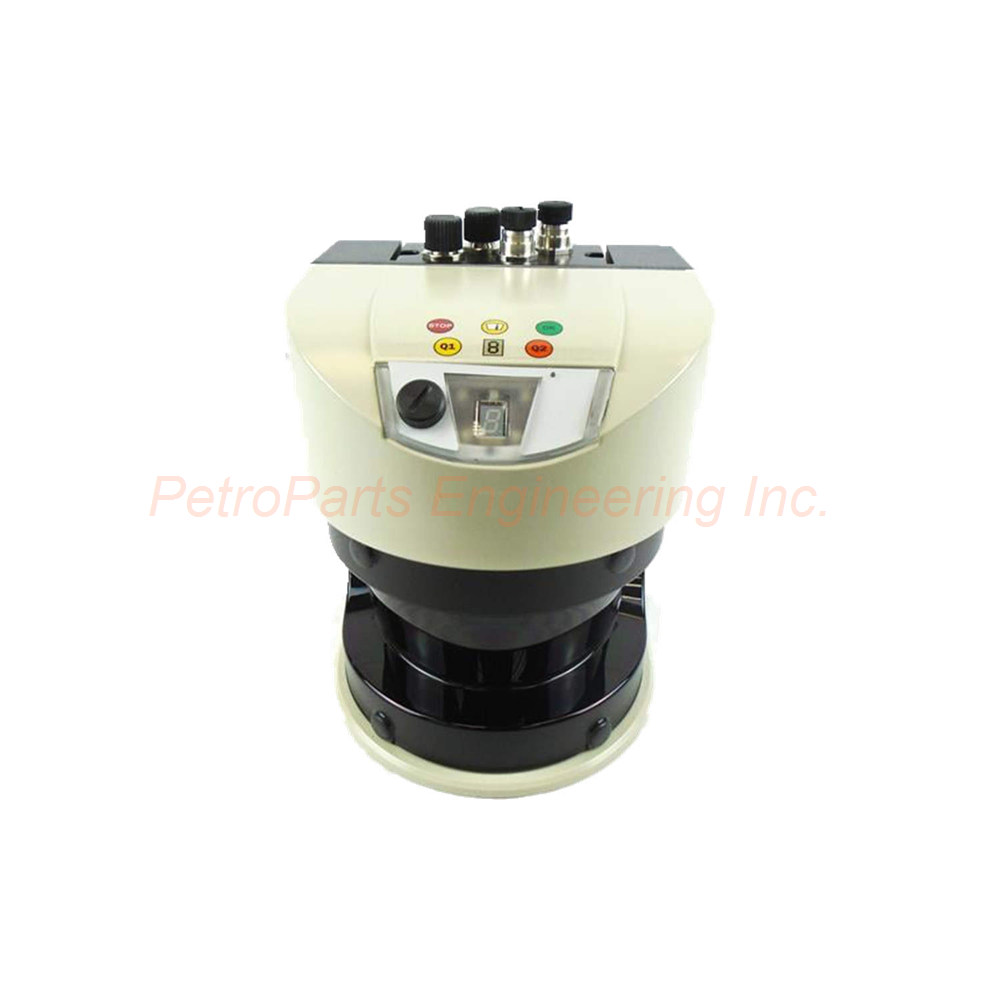
SICK LMS511-20100 Laser Scanner | Outdoor 80m 190°

Introduction:
The SICK LMS511-20100 PRO outdoor laser scanner offers 80m range with 190° scan angle. Features 100Hz scan rate, heating, IP67, and 10 fields.
 Customer Reviews
UBEST Automation – Trusted Global Automation Parts Supplier
We offer a wide range of in-stock industrial automation spare parts. All products come with a 12-month warranty and a 30-day refund for quality issues.
Product Attributes:
Notice: For real-time prices and inventory, please click the button below to contact us.
SICK LMS511-20100 2D Laser Scanner Infrared Outdoor
The SICK LMS511-20100 is a 2D laser scanner from the LMS511 PRO series. This unit handles both outdoor and indoor applications with equal capability. Specifically, the LMS511-20100 offers high resolution power for detailed environment scanning. The light source uses infrared at 905 nm (± 10 nm) for invisible detection. For perimeter monitoring and object detection, engineers choose this scanner. Outdoor infrastructure and industrial sites benefit from its rugged design.
Laser Safety and Aperture Angle
Regarding laser safety, the class reaches Class 1 per EN/IEC 60825-1:2014 standards. Compliance with EN 60825-1:2014+A11:2021 ensures complete eye safety. Consequently, no special laser safety equipment is needed during operation. The horizontal aperture angle measures 190° for wide area coverage. Due to this wide angle, the scanner suits large outdoor spaces. Ports, airports, and mining sites benefit from this extensive field of view.
Scanning Frequency and Angular Resolution
Six configurable scanning frequencies provide exceptional application flexibility. Available frequencies include 25 Hz, 35 Hz, 50 Hz, 75 Hz, and 100 Hz. Higher scan rates capture faster moving objects with better detail. On the other hand, lower scan rates provide more processing time per measurement. For angular resolution, eight different options are available. You can choose from 0.042° (interlaced), 0.083° (interlaced), 0.1667°, 0.25°, 0.333°, 0.5°, 0.667°, or 1.0°. Finer resolution detects smaller objects, yet it increases data output volume. The interlaced options provide enhanced resolution through multiple scans.
Scan Field Flatness and Conical Error
Turning to scan field geometry, the flatness combined measures ± 0.72° for consistent scanning. The typical conical error sits at 0.11° ± 0.1° at 1 sigma value. Because this error remains low, accurate positioning occurs across the entire scan field. The typical tilt measures 0.15° ± 0.08° at 1 sigma value. Even with minor mounting angle variations, reliable data is provided.
Heating System for Cold Environments
For cold weather operation, the LMS511-20100 includes self-heating with additional integrated heating. Standard self-heating maintains basic functionality in cool conditions. The additional integrated heating enables operation down to -30°C. Power consumption for heating reaches 55 W typical. Therefore, this scanner suits freezing outdoor environments reliably.
Working Range and Scanning Capabilities
Versatile coverage comes from a working range of 0.2 m to 80 m. At 10% remission factor, however, the scanning range reaches 26 m reliably. Darker objects with lower reflectivity will produce shorter effective ranges. Precise distance data comes from ± 12 mm measurement accuracy. Furthermore, the amount of evaluated echoes reaches 5 for superior reliability. Rejecting spurious reflections from rain, dust, or fog is possible with five echoes.
Spot Size and Beam Divergence
Regarding the laser beam, divergence measures 4.7 mrad for the emitted pulse. A 13.5 mm spot size appears at the viewing window. At 26 meters distance, however, the spot expands to 136 mm. At 40 meters distance, the spot size reaches 202 mm. Consequently, larger spots may average over small object features at long range.
Electrical Specifications and Power Requirements
For connections, the sensor includes 4 x M12 round connectors for various interfaces. The supply voltage requires 24 V DC with ± 20 % tolerance. Therefore, the acceptable range spans from 19.2 V to 28.8 V DC. Normal operation consumes 22 W of power for scanning. For heating, add 55 W typical in cold conditions. Total maximum consumption reaches approximately 77 W.
Mechanical Construction and Materials
AlSi12 aluminum alloy forms the housing for strength and heat dissipation. Easy identification comes from the gray (RAL 7032) housing color. For optical clarity, the window uses polycarbonate with scratch-resistant coating. Per EN 60529, Section 14.2.7, the enclosure rating reaches IP65 and IP67. Consequently, the sensor resists dust ingress and temporary immersion. For heavy rain and washdown, IP67 provides extra protection. Safety extra low voltage operation is ensured by Protection Class III per IEC 61140:2016-11.
Dimensions and Weight
Moving to physical size, the dimensions (L x W x H) measure 160 mm x 155 mm x 185 mm. Stable installation comes from a 3.7 kg weight. For this reason, use sturdy mounting brackets to support this weight securely.
Reliability and Performance Parameters
Regarding reliability, the MTBF exceeds 100 years for exceptional performance. Similarly, the MTTFD exceeds 100 years for safety-related calculations. Fast detection of moving objects comes from a ≥ 10 ms response time. Due to the active LiDAR principle, the detectable object shape is almost any.
Measurement Errors and Accuracy
Distance from the sensor affects the systematic error. From 1 m to 10 m, the error equals ± 25 mm. From 10 m to 20 m, however, the error expands to ± 35 mm. Distance also affects the statistical error accordingly. A 7 mm error appears from 1 m to 10 m. From 10 m to 20 m, the error equals 9 mm.
Integrated Application and Field Evaluation
Real-time zone monitoring comes from the field evaluation integrated application. Your control system receives continuous measurement data output. Complex zone definitions are supported by 10 field sets. For multiple independent monitoring tasks, 10 simultaneous evaluation cases are available. As a result, one scanner can protect ten different areas simultaneously.
Filter Options for Reliable Detection
Several filters improve detection reliability in challenging conditions. Spurious reflections from unwanted objects are rejected by the echo filter. Similarly, the fog filter improves performance in humid or misty environments. Small dust or debris particles are ignored by the particle filter effectively. Meanwhile, noisy measurements are smoothed by the average filter for stable output. Finally, interference from bright light sources is handled by the glare filter.
Communication Interfaces and Protocols
For networking, the LMS511-20100 includes Ethernet with TCP/IP and UDP/IP protocols. OPC server communication is supported for industrial integration. Host and AUX functions plus NTP time synchronization are provided. Fast data transfer comes from a 10/100 MBit/s transmission rate. Additionally, serial communication supports RS-232 and RS-422 standards. Host and AUX functions are also supported by this interface. From 9.6 kBaud to 500 kBaud, the data transmission rate ranges.
CAN interface serves for output extension and synchronization. Data transmission rates include 20 kBit/s, 500 kBit/s, and 1 MBit/s. For service access, USB with Mini-USB connector is available as a service interface.
Digital Inputs and Outputs
For external triggers, the scanner provides 4 digital inputs. These inputs support encoder (HTL) and synchronization functions. For alarm and status signaling, 6 digital outputs are available. For quick status checking, 5 LEDs serve as optical indicators. Additionally, error codes and configuration information appear on a 7-segment display.
Ambient Conditions and Object Remission
From 2% to > 1,000% including reflectors, the object remission range spans. Very dark objects (2% remission) produce the shortest detection ranges. In contrast, reflectors (>1,000% remission) produce the longest detection ranges. From -30 °C to +50 °C, the ambient operating temperature ranges with heating active. For warehouse conditions, storage temperature spans from –40 °C to +70 °C. Furthermore, 70,000 lx ambient light immunity ensures reliable operation in bright sunlight.
Environmental Compliance and Immunity
Regarding EMC, emitted radiation complies with IEC 61000-6-3:2020. For industrial environments, EN IEC 61000-6-3:2007+A1:2011 is also met. For immunity, compliance meets IEC 61000-6-2:2016 and EN IEC 61000-6-2:2019. Vibration resistance follows sine test at 10 Hz to 150 Hz. From 0.35 mm to 5 g, amplitude ranges for 20 cycles. For shock, resistance withstands 15 g at 11 ms for 6 single shocks per axis. Additionally, 10 g at 16 ms for 1,000 continuous shocks per axis is tolerated. Per DIN EN 50102:09-1997, impact resistance meets IK05, IK06, and IK07.
Important Usage Note
Please note that the SICK LMS511-20100 does not constitute a safety component. Relevant legislation for machine safety applications is not met. Therefore, for safety-critical functions, select a certified safety laser scanner instead. This scanner serves monitoring, measurement, and outdoor infrastructure applications only.
Step-by-Step Installation Guide
Follow these steps to install your SICK LMS511-20100 correctly.
Step 1: Select the Mounting Location
First, choose a location with a clear 190° view of the monitoring area. Outdoor or indoor mounting within -30°C to +50°C is acceptable. Strong light sources directly in the beam path should be avoided. Then, ensure the mounting surface can support the 3.7 kg weight.
Step 2: Mount the Scanner Securely
Next, attach the LMS511-20100 using M6 mounting bolts. Use the mounting holes on the gray AlSi12 housing. Tighten bolts to the specified torque value without exception. For outdoor installations, ensure the IP67 seal is intact.
Step 3: Connect Power, Heating, and Ethernet
After mounting, wire the 24 V DC power supply to the appropriate M12 connector. Connect the heating power separately if using low-temperature operation. Connect the Ethernet M12 connector to your network switch for TCP/IP communication. Then, verify all connections are tight before applying power.
Step 4: Configure the Scanning Parameters
Now, access the sensor configuration software via Ethernet or OPC. Select the scanning frequency between 25 Hz and 100 Hz for your application. Choose the angular resolution from eight options as needed. Then, configure the echo, fog, and particle filters for your specific environment.
Step 5: Define the 10 Protection Fields
Using the software, draw the 10 field sets for zone monitoring. For each field, set the working range between 0.2 m and 80 m. For complex monitoring, define up to 10 simultaneous evaluation cases. Then, test each field set thoroughly with a moving object.
Step 6: Test the Detection Functions
Apply power to the LMS511-20100 and observe the LED indicators. Move an object through each monitoring zone to verify detection. Check whether the digital outputs activate at the correct distances. For outdoor use, test during various weather conditions. Finally, document all configuration settings for future reference.
Complete Package Contents
Your SICK LMS511-20100 shipment includes the following items:
SICK LMS511-20100 2D Laser Scanner (1 unit)
4 x M12 connector caps for unused ports
Product documentation and quick start guide
Configuration software download card
Mounting instructions for outdoor installation
Note: Shipping partners include FedEx, UPS, and DHL.
Frequently Asked Questions (FAQ)
Q1: What is the maximum scanning range of the LMS511-20100?
Under ideal conditions, the working range reaches 80 meters for the LMS511-20100. At 10% target remission, however, the reliable scanning range is 26 meters. Very dark objects at 2% remission will produce shorter detection distances.
Q2: What makes the LMS511-20100 suitable for outdoor use?
The SICK LMS511-20100 includes integrated heating for -30°C operation. It also has IP67 rating for temporary immersion protection. The five-echo evaluation rejects rain and fog interference effectively.
Q3: What scanning frequencies does this sensor support?
Six configurable scanning frequencies are supported by the LMS511-20100. These include 25 Hz, 35 Hz, 50 Hz, 75 Hz, and 100 Hz. The highest frequency (100 Hz) captures very fast-moving objects with excellent detail.
Q4: How many field sets can the LMS511-20100 monitor?
The LMS511-20100 supports up to 10 field sets for complex zone definitions. It also supports 10 simultaneous evaluation cases for independent monitoring tasks. Consequently, one scanner can protect ten different areas simultaneously.
Q5: What communication protocols are available on this scanner?
The SICK LMS511-20100 includes Ethernet (TCP/IP, UDP/IP) with OPC support. Serial RS-232 and RS-422 are available for legacy systems. CAN interface provides output extension and encoder synchronization. For configuration, a Mini-USB service port is also provided.
Welcome to learn about our business. We are a leading global provider of automation equipment and will provide you with complete and cost-effective product solutions. You are welcome to choose us, and our services will make you a long-term partner like our other customers.
Now please let us know your needs and suggestions.
About Ubest
Ubest Automation is a leading global provider of automation products, with deep partnerships with major automation manufacturers to provide customers with customized business solutions, cost-effective products, and comprehensive services.
Product Center
Contact Us
Phone:+86 180 3000 5825
Address:Room 7A, No. 59 Hubin North Road, Siming District Xiamen City China
Email: sales@ubestplc.com
Contact: Klaus
Industry Links
© 2026, Ubest Automation Limited All Rights Reserved. sitemap