Siemens and AGIBOT Show Agentic AI Gripper Design at Formnext 2026
2026-11-22

ExcerptBy Wayne — Sales Engineer TL;DR: Siemens announced on 16 November 2026 an agentic AI workflow that designs a gripper for a humanoid robot from a natural-language task description, with AGIBOT as the demonstration partner. The workflow selects a gripper type, adapts the geometry in Siemens’ Designcenter, simulates it and prepares additive-manufacturing data through MCP […]
TL;DR: Siemens announced on 16 November 2026 an agentic AI workflow that designs a gripper for a humanoid robot from a natural-language task description, with AGIBOT as the demonstration partner. The workflow selects a gripper type, adapts the geometry in Siemens’ Designcenter, simulates it and prepares additive-manufacturing data through MCP integration. A separate adaptive production cell with EOS and AM Solutions is planned at Siemens’ Electronics Factory in Erlangen, not in production. Formnext 2026 ran from 17 to 20 November, so a 21 November launch date is incorrect.
The announcement has been reported as a four-company launch on 21 November at Formnext 2026. The official record is narrower and more useful. Siemens published a press release on 16 November 2026, the day before Formnext opened, and demonstrated the gripper workflow during the show, which closed on 20 November. AGIBOT supplied the humanoid-robot use case; EOS and AM Solutions are attached to a different workstream, a production cell that Siemens says it is creating rather than operating. This article separates the confirmed record from the planned work and from details that have not been disclosed.
What did Siemens actually announce at Formnext 2026?
Siemens announced a demonstration, not a product launch. Its 16 November 2026 release describes an agentic AI workflow that turns a described handling task into a printable humanoid-robot gripper, built with AGIBOT. The workflow was shown at Formnext 2026 in Frankfurt, which ran from 17 to 20 November; the release is dated the day before the show opened.
The Siemens press release is titled around Industrial AI and additive manufacturing for adaptive product development and production. It announces three things: an agentic AI workflow for prompt-based engineering of a robotic gripper, an adaptive production cell for additive manufacturing, and an updated AM I Navigator that helps companies prioritise Industrial AI use cases. The gripper is the demonstration; the production cell is the next step; the navigator is a consulting tool.
Timing matters because the brief that circulated placed the announcement on 21 November. Mesago’s official Formnext page lists the 2026 show as 17–20 November at Messe Frankfurt, in halls 11 and 12 plus the Portalhaus. Siemens dated its release 16 November. A 21 November event would therefore have fallen after the exhibition closed, and Siemens has published no separate launch on that date. The correct description is a press release plus a live demonstration during the show.
The announcement also fits an existing Siemens theme rather than arriving from nowhere. The company has been positioning agentic engineering as a layer above its industrial software, including the Eigen engineering agent it began reselling in the United States. The Formnext demo extends that idea from configuration and engineering assistance into a physical design-to-print loop.
Who are AGIBOT, EOS and AM Solutions, and what is each one doing?
AGIBOT is a Shanghai-based humanoid robotics company and the demonstration partner for the gripper use case. EOS supplies industrial additive-manufacturing systems, and AM Solutions, a Rösler Group brand, supplies automated post-processing. EOS and AM Solutions are named as partners for the planned Erlangen production cell, not as participants in the design demonstration.
AGIBOT’s registered English name is AGIBOT Innovation (Shanghai) Technology Co., Ltd.; the Chinese entity is Zhiyuan Innovation (Shanghai) Technology. Its own description is a general-purpose embodied-intelligence robotics company, founded in 2023 and focused on humanoid platforms and the algorithms around them. In the Siemens release, AGIBOT is the application context: the part being designed is a gripper for a humanoid robot, and the handling task comes from that use case. The release contains no AGIBOT quotation and no statement of which AGIBOT robot model is involved.
EOS GmbH is the German industrial 3D printing supplier whose portfolio covers metal and polymer additive-manufacturing systems. Its chief executive, Marie Niehaus-Langer, is quoted in the Siemens release saying that combining Siemens’ automation, software and AI expertise with EOS’ additive-manufacturing expertise should advance what she calls an independent European approach to manufacturing. AM Solutions is the 3D post-processing brand of Rösler Oberflächentechnik GmbH, the Rösler Group. David Soldan, who heads AM Solutions, is quoted on the need to integrate downstream processing into the production chain rather than treating printing as the end of the process.
| Company | Role in the announcement | Official statement in the release |
|---|---|---|
| Siemens | Issues the release; supplies Designcenter, automation, software and Industrial AI; plans the Erlangen cell | Yes — Karsten Heuser, Vice President Additive Manufacturing |
| AGIBOT | Humanoid-robot application partner for the gripper demonstration | Named only; no quote or separate statement in the release |
| EOS | Industrial additive-manufacturing systems; partner for the planned Erlangen production cell | Yes — Marie Niehaus-Langer, CEO |
| AM Solutions | 3D post-processing technology, a Rösler Group brand; partner for the planned Erlangen cell | Yes — David Soldan, Head of AM Solutions |
How does the agentic AI gripper workflow actually work?
The user describes the object to be handled and the task in natural language. An AI agent then selects a gripper type, adapts the geometry in Siemens’ Designcenter, simulates the design, validates the robot interface and handling, and prepares the data for additive manufacturing. MCP integration lets the agent call functions inside the engineering software.
The sequence in Siemens’ release is specific enough to be useful and general enough to leave engineering questions open. It runs as follows:
- The operator describes the object and the handling task in natural language.
- The agentic AI workflow interprets the requirement and selects a suitable gripper type.
- The agent adapts the gripper geometry in Siemens’ Designcenter.
- The workflow simulates the design.
- It validates the robot interface and the handling behaviour.
- It prepares the data for additive manufacturing.
What the release does not provide is equally important. It does not name the simulation solver, the print-preparation software, the robot model, the gripper material or the additive-manufacturing system used in the demonstration. It also does not publish cycle times, success rates or test results. The claim that the workflow performs “grasp simulation” is a reasonable paraphrase of “simulates it” and “validates the robot interface and handling”, but it is not Siemens’ wording. The final step is data preparation for printing, not physical production.
The architectural idea is that the agent sits above the toolchain rather than replacing it. Through MCP, it can access software functions and orchestrate steps that an engineer would otherwise perform in separate applications. Siemens frames the benefit as access: complex engineering workflows become usable by people who do not operate every tool directly. That is a claim about the interface layer, not yet a measured productivity result.
Is “Siemens Designcenter” a real product or a media error?
Designcenter is a real Siemens software suite for product development, offered in browser and desktop versions and built on the Parasolid kernel. It is not a media invention or a mis-transcription. Siemens’ release does not name the specific Designcenter application, module or licence that performs the gripper geometry changes.
Siemens’ own product page describes Designcenter as a complete software suite for product development, spanning mechanical and electrical CAD, simulation, manufacturing and data management. The suite includes Designcenter and Designcenter Solid Edge, both built on the Parasolid geometric kernel. The naming reflects a portfolio brand rather than a single executable, which is why secondary coverage sometimes renders it awkwardly.
The ambiguity is about scope, not existence. Designcenter is a large suite, and Siemens does not say which part of it the agent manipulates when it adapts the gripper. That could be a CAD modelling function, a configuration or template mechanism, or a higher-level automation layer exposed through MCP. Without that detail, readers should not assume the demo uses a particular module, a particular licence tier or a specific release. The safe description is “Siemens’ Designcenter suite”, exactly as the release words it.
Is MCP officially part of the workflow, or a media gloss?
MCP is official. Siemens’ release states that “through MCP integration, the AI agent can access functions of the engineering software and orchestrate the required work steps”. The release uses the abbreviation only; it does not spell out Model Context Protocol, which is the standard expansion used by the wider industry and by secondary coverage.
The distinction is small but worth keeping. Siemens confirms MCP as the integration mechanism, so the protocol is not an invention of the coverage. What the release does not do is define the protocol, list the exposed functions, describe authentication or say whether the integration is productised, preview-only or custom for the demonstration. Nor does it say whether third-party software can be added to the same agent.
For industrial buyers, the open questions are the ones that decide deployability: which software functions are callable, how permissions are governed, whether the agent can write back into a managed CAD or PLM environment, and how an audit trail is produced. The release addresses governance only at a high level, saying that quality, traceability, security and human responsibility remain requirements. That is a principle, not an implementation detail.
The broader direction is consistent with other agentic-automation work reaching the plant floor, including the agentic AI acquisitions covered on this site. What differs here is the loop: the agent is not only answering questions or configuring software, but producing a design artifact that is meant to be printed.
How does the agentic workflow compare with traditional gripper development?
Traditional gripper projects move through separate steps: requirement capture, catalogue selection, CAD modelling, simulation, robot-interface checks and print preparation, often in different tools. Siemens’ demonstration chains those steps through one agent and MCP access. The comparison covers the design loop only; physical production still depends on the planned Erlangen cell.
A conventional task-specific gripper project is a sequence of handoffs. An engineer interviews the process owner, writes a requirement, selects a commercially available gripper or starts a custom design, models it in CAD, sets up a simulation, checks the robot flange and payload, then prepares the part for printing or machining. Each handoff costs time and introduces interpretation error. The agentic demo compresses the chain by letting one instruction trigger the sequence, with the agent calling the tools rather than a person opening each one.
| Step | Traditional approach | Agentic workflow in the demo | Confirmed at Formnext? |
|---|---|---|---|
| Requirement capture | Engineer interviews and written specification | User describes object and task in natural language | Yes |
| Gripper selection | Manual catalogue or supplier selection | AI selects a suitable gripper type | Yes |
| Geometry | Manual CAD adaptation per application | Agent adapts geometry in Siemens’ Designcenter | Yes |
| Simulation | Separate CAE setup and run | Workflow simulates the design | Yes; method not detailed |
| Robot interface and handling | Manual checks and physical trials | Workflow validates interface and handling | Yes; method not detailed |
| AM data preparation | Specialist prepares build data | Workflow prepares data for additive manufacturing | Yes |
| Physical production | External print job or existing line | Planned Erlangen cell with EOS and AM Solutions | No — planned |
The comparison also explains why the announcement pairs design with production. A prompt-driven design loop can generate more variants than a conventional line can absorb, so the bottleneck moves downstream. That is the logic behind the adaptive cell: Siemens argues that if design becomes flexible, production must become flexible too. The argument is coherent, but the cell is not yet the evidence.
What is the Erlangen adaptive production cell, and is it running?
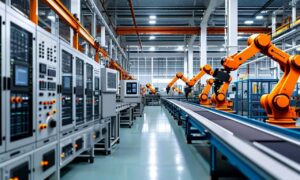
It is a planned production environment at Siemens’ Electronics Factory in Erlangen, being created with EOS and AM Solutions to link printing, automation, post-processing and software. Siemens’ own image caption calls it “the planned adaptive production cell”. It is not described as operational, and no start date, line name or product family has been published.
The release says Siemens is creating a production environment at its Electronics Factory in Erlangen in which additive manufacturing, automation and software are designed to work together in an integrated process chain. EOS provides the additive-manufacturing side; AM Solutions provides post-processing, which the release treats as part of the cell from the outset rather than an afterthought. The stated goal is to handle different components and production requirements flexibly while creating conditions for repeatable and scalable processes.
Those are design goals, not operating results. The release publishes no throughput, no part family, no qualification data and no commissioning date. Siemens’ photo caption uses “planned”. Anyone modelling the cell should therefore treat it as a development and demonstration environment, not as an available production capability. The same caution applies to the gripper workflow: the design loop was demonstrated, but the physical print-and-post-process chain that would complete it is still being built.
The cell concept also connects to work elsewhere on digital production lines. Rockwell’s Emulate3D digital-twin demonstrations and Beckhoff’s SPS 2026 automation lineup pursue the same goal from different starting points: making a physical line reconfigurable enough to absorb product variation. Siemens’ angle is to start from the design agent and push the variation downstream.
What is confirmed, what is planned, and what is not disclosed?
Confirmed: a Formnext demonstration with AGIBOT, the six-step workflow, MCP integration and three named partners with quotes. Planned: the Erlangen cell with EOS and AM Solutions. Not disclosed: cycle times, gripper materials, print-system models, cell throughput, qualification data, investment, start date and the first production part.
The confirmed list is short enough to audit. Siemens published the release on 16 November 2026, demonstrated the workflow at Formnext between 17 and 20 November, named AGIBOT as the humanoid-robot partner, named EOS and AM Solutions as partners for the Erlangen cell, and quoted executives from Siemens, EOS and AM Solutions. It described the six workflow steps and the MCP integration. Those points are safe to cite.
The planned list contains the production cell, the integration of printing, automation and post-processing, and the objective of repeatable, scalable production. The not-disclosed list is where most procurement questions land: cycle time, part cost, material qualification, machine models, cell footprint, integration effort, data model, cybersecurity architecture and commercial availability. None of these appears in the release, and none should be inferred from the demo.
There is also a vision layer that should not be mistaken for a roadmap. Siemens frames Industrial AI as the next stage of Industry 4.0 and additive manufacturing as its natural complement. That is a strategic position, not a delivery commitment. The concrete commitments in the release are a demonstration, a cell under creation and an updated AM I Navigator.
What does this mean for plant and procurement teams?
Treat the announcement as an engineering-automation signal, not a purchasable system. The near-term value is shorter design loops for task-specific grippers; the production claim depends on a cell that is still being built. Buyers should ask for validated interfaces, material data and post-processing specifications before planning around it.
The practical near-term change is in engineering effort. If a described task can produce a validated, printable gripper design without an engineer opening every tool, the cost of customisation falls and the range of parts worth automating widens. That matters for high-mix lines where a dedicated gripper is hard to justify. The relevant internal questions are who owns the agent’s output, how designs are reviewed, and how the generated geometry is controlled in a managed CAD environment.
The production side is further away. An adaptive cell that prints, post-processes and moves parts without manual intervention needs machine qualification, material data, handling standards and traceability. EOS and AM Solutions bring the printing and post-processing pieces, and Siemens brings automation and software, but the release does not publish the integration results. Teams evaluating the concept should ask for a commissioned reference, not a show-floor demo.
For spare-parts and automation buyers, the more immediate levers remain conventional: correct servo sizing, reliable robot interfaces and documented motion components. The industrial robotics product range and the servo drives and motion control catalogue are where those decisions are made today. Components such as the Yaskawa SGDM-08ADA servo drive and the Mitsubishi HG-SR152J servo motor illustrate the level of validated detail that an agentic design loop would eventually have to handle. Siemens’ own installed base is covered in the Siemens automation and drive products collection.
Frequently asked questions
The answers below separate the official Siemens record from secondary reporting and from the original brief, which placed the announcement on 21 November 2026. Where Siemens has not published a detail, the answer says so rather than filling the gap with an estimate.
Did Siemens announce the gripper workflow on 21 November 2026?
No. Siemens published the release on 16 November 2026, and Formnext 2026 ran from 17 to 20 November in Frankfurt. A 21 November date falls after the show closed. The workflow was demonstrated during the show; no separate launch event on 21 November has been reported by Siemens.
Is the agentic gripper workflow in production?
No. Siemens describes a demonstration at Formnext and a production cell that is being created. Neither the design workflow nor the cell is presented as an operating production system. Siemens’ release gives no throughput, cycle-time or qualification figures for either.
What exactly is Siemens’ Designcenter?
Designcenter is Siemens’ product-development software suite, offered in browser and desktop versions and built on the Parasolid kernel. It includes Designcenter and Designcenter Solid Edge. Siemens does not identify which application inside the suite adapts the gripper geometry in the Formnext demonstration.
Does the workflow use the Model Context Protocol?
Siemens confirms MCP integration: the release says the AI agent can access engineering-software functions through MCP. The release does not spell out Model Context Protocol, but that is the standard expansion of the abbreviation. It also does not list which software functions are exposed to the agent.
Will the Erlangen adaptive production cell be built?
Siemens says it is creating the production environment at its Electronics Factory in Erlangen with EOS and AM Solutions, and its image caption calls it the planned adaptive production cell. No completion date, investment figure, line name or first product has been disclosed, so the schedule remains open.
Are all four companies equally involved in the announcement?
No. Siemens issued the release and provides the software, automation and AI. AGIBOT is the humanoid-robot partner for the gripper demonstration but has no quote in the release. EOS and AM Solutions are partners for the planned Erlangen cell and both provide quotes.
Sources
The facts in this article are drawn from Siemens’ 16 November 2026 press release, Formnext’s official dates and the published corporate pages of EOS, AM Solutions and AGIBOT. Secondary coverage was used only to identify claims that needed checking, not as a primary source.
Related Posts