
MTL5011B Proximity Detector Repeater | Zone 0 IIC with Line Fault Detect
Introduction:
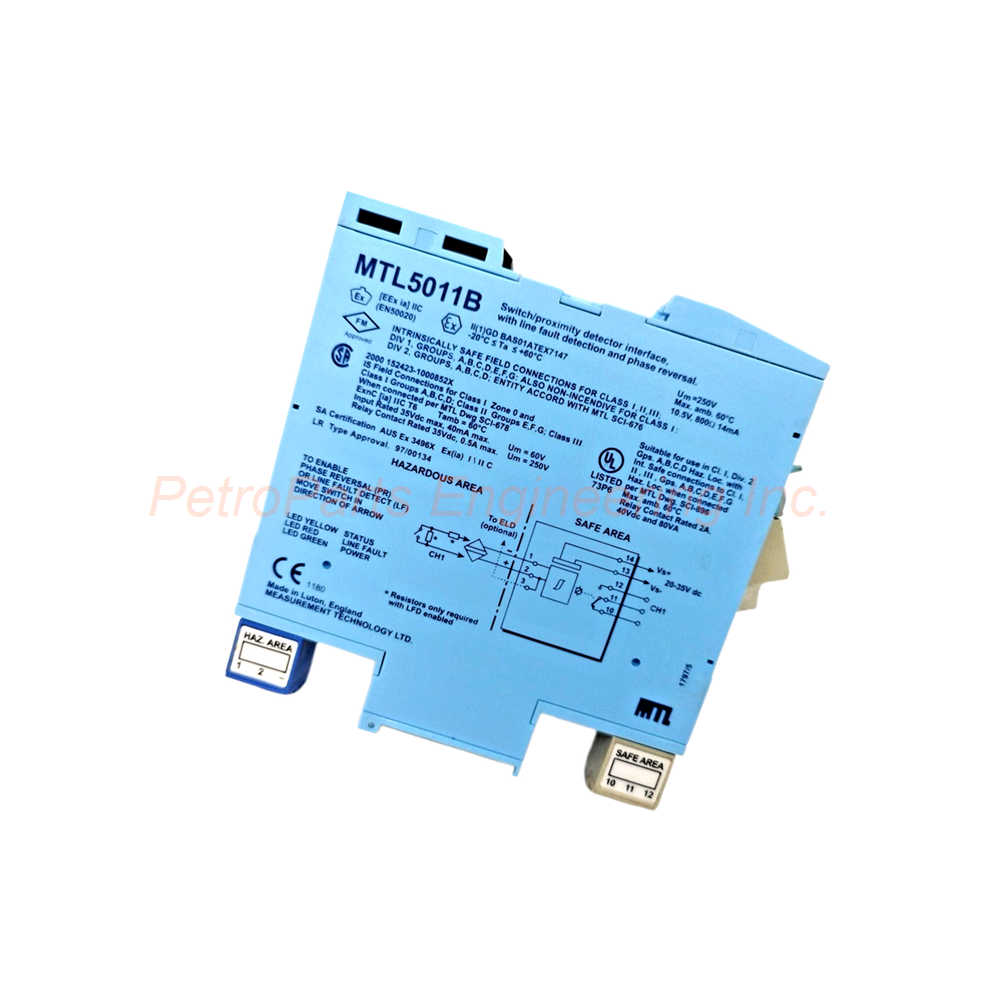
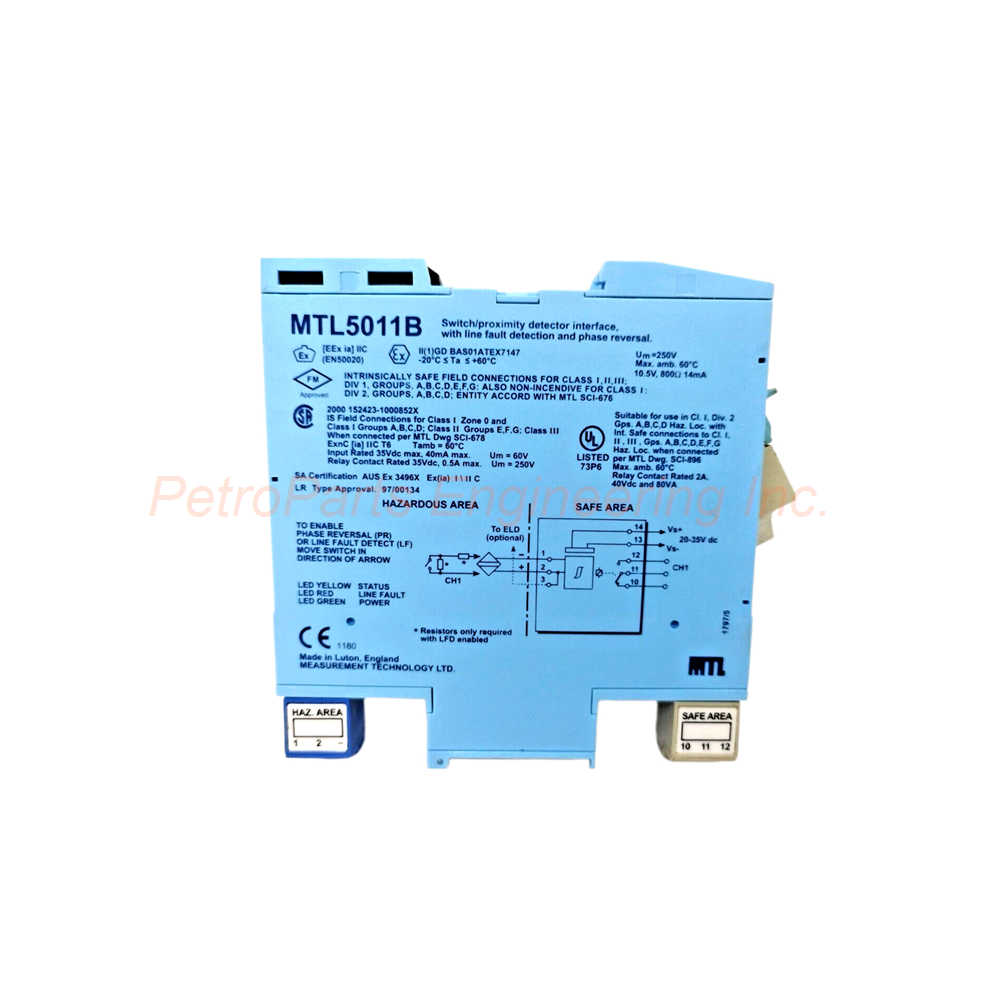
The MTL5011B is an isolated switch/proximity detector repeater with relay output. It features NAMUR input and selectable line fault detection.
 Customer Reviews
UBEST Automation – Trusted Global Automation Parts Supplier
We offer a wide range of in-stock industrial automation spare parts. All products come with a 12-month warranty and a 30-day refund for quality issues.
Product Attributes:
Notice: For real-time prices and inventory, please click the button below to contact us.
Eaton MTL5011B Isolated Switch Repeater with Relay Output
Product Overview
A flexible isolated repeater arrives as the MTL5011B from Eaton’s MTL series. This device enables safe-area loads to be controlled by hazardous-area switches. The MTL5011B accepts input from mechanical switches or NAMUR proximity detectors. Engineers use this unit for alarm annunciation, motor control, and interlock systems. Consequently, the MTL5011B suits Zone 0, IIC, T6 hazardous areas for switches. The unit features a single-pole changeover relay output for versatile load control. Furthermore, selectable line fault detection (LFD) identifies open or short circuits in field wiring.
Technical Specifications
| Parameter | Specification |
|---|---|
| Manufacturer | Eaton (MTL) |
| Model | MTL5011B |
| Product Type | Isolated Switch/Proximity Detector Repeater |
| Number of Channels | 1 |
| Switch Location | Zone 0, IIC, T6 / Div. 1, Group A |
| Proximity Detector Location | Zone 0, IIC, T4-T6 / Div. 1, Group A |
| Input Standard | NAMUR/DIN 19234 |
| Relay Type | Single-pole changeover |
| Relay Contact Rating (AC) | 250V, 2A, cosø >0.7 |
| Relay Contact Rating (DC) | 40V, 2A (resistive load) |
| Response Time | 10ms maximum |
| Current Consumption (20V) | 40mA |
| Current Consumption (24V) | 35mA |
| Current Consumption (35V) | 25mA |
| Power Dissipation (24V) | 0.75W |
| Power Dissipation (35V) | 0.8W |
| Isolation Voltage | 250V AC/DC |
| Safety Description | 10.5V, 800Ω, 14mA; Um=250V rms/DC |
Terminal Functions
The MTL5011B uses clearly numbered terminals for straightforward wiring.
| Terminal | Function |
|---|---|
| 1 | Input –ve |
| 2 | Input +ve |
| 3 | Earth leakage detection |
| 10 | Normally-closed contact |
| 11 | Common |
| 12 | Normally-open contact |
| 13 | Supply –ve |
| 14 | Supply +ve |
This clear terminal assignment simplifies installation and troubleshooting. The relay output provides both normally-open and normally-closed contacts. Thus, wiring flexibility accommodates both energize-to-run and energize-to-stop applications.
Hazardous-Area Input Specifications
The MTL5011B accepts input from switches or NAMUR proximity detectors. Input conforms to NAMUR/DIN 19234 standards for proximity detector compatibility. Voltage applied to the sensor ranges from 7 to 9V from a 1kΩ ±10% source. Thus, the MTL5011B works with most industrial NAMUR sensors. Input current varies with the sensor or switch state for reliable detection.
For mechanical switches, external resistors enable line fault detection. A 500Ω to 1kΩ resistor connects in series with the switch. A 20kΩ to 25kΩ resistor connects in parallel with the switch. Thus, the MTL5011B distinguishes between open, closed, and fault conditions.
Input/Output Characteristics
The MTL5011B provides user-selectable phase reversal for flexible control. Normal phase operation energizes the output when input current exceeds 2.1mA. Reverse phase operation energizes the output when input current drops below 1.2mA. Thus, the MTL5011B can signal an alarm for either state of the sensor. Hysteresis measures 200µA typically, so output switching remains stable and bounce-free.
Output energizes when input current exceeds 2.1mA or resistance falls below 2kΩ. Output de-energizes when input current drops below 1.2mA or resistance exceeds 10kΩ. Therefore, the MTL5011B responds reliably to both proximity detectors and mechanical switches.
Relay Output Specifications
The MTL5011B provides a single-pole changeover relay for load control. Relay contacts are rated at 250V AC, 2A with power factor above 0.7. For DC loads, the rating is 40V, 2A for resistive loads only. Thus, the MTL5011B controls small motors, alarms, lamps, and PLC inputs. Response time reaches 10ms maximum from input change to output switching.
Reactive loads must be adequately suppressed to prevent contact damage. Inductive loads like relays and solenoids require flyback diodes or RC snubbers. Therefore, install appropriate suppression across the load for reliable long-term operation. The relay contacts are not rated for high-inrush loads like incandescent lamps.
Line Fault Detection (LFD)
The MTL5011B includes user-selectable line fault detection via top switches. Line fault detection identifies open or short circuits in the field wiring. Thus, the MTL5011B provides diagnostic information beyond simple switch status. A red LED illuminates when a line fault is detected for quick identification. A detected line fault de-energizes the relay for fail-safe operation.
Open-circuit alarm activates when input current falls below 100µA. Open-circuit alarm resets when input current rises above 250µA. Short-circuit alarm activates when input resistance falls below 100Ω. Short-circuit alarm resets when input resistance rises above 360Ω. Therefore, the MTL5011B distinguishes between normal off state and wiring faults.
External resistors are required when using LFD with a contact input. Without these resistors, the unit cannot differentiate between closed switch and short circuit. Thus, always install series and parallel resistors for mechanical switch applications.
Phase Reversal Selection
The MTL5011B allows user-selectable phase reversal via top switches. Normal phase means the relay energizes when the sensor detects a target. Reverse phase means the relay energizes when the sensor detects no target. Thus, the MTL5011B adapts to normally-open or normally-closed sensor configurations. This flexibility eliminates the need for external logic inverters.
Phase reversal also affects line fault detection behavior. When the relay de-energizes during a fault, the normal/reverse setting determines safe state. Therefore, select phase reversal to achieve fail-safe operation for your application.
LED Indicators
The MTL5011B features three LED indicators for comprehensive status monitoring. Green LED indicates power is present and the unit is operating. Yellow LED indicates the channel status when the output relay is energized. Red LED indicates a line fault has been detected in the field circuit. Thus, technicians can diagnose system status at a glance.
The yellow LED follows the relay state, not the input state directly. Phase reversal affects the relationship between input and yellow LED. Therefore, understand your phase selection when interpreting the yellow LED. The red LED illuminates only when LFD is enabled and a fault exists.
Power Supply and Isolation
The MTL5011B requires 20 to 35V DC supply voltage for operation. Current consumption varies from 40mA at 20V to 25mA at 35V. Thus, the MTL5011B consumes less power at higher supply voltages. Power dissipation reaches 0.75W at 24V and 0.8W at 35V maximum.
Isolation withstands 250V AC or DC between all circuit groups. Power supply, hazardous-area circuits, and relay outputs are all isolated from each other. Therefore, the MTL5011B provides three-port isolation for maximum system safety. The safety description specifies 10.5V, 800Ω, 14mA output parameters.
Hazardous Area Compatibility
The MTL5011B suits demanding hazardous area installations globally. Mechanical switches can locate in Zone 0, IIC, T6 hazardous areas. Proximity detectors require Zone 0, IIC, T4-T6 certification for the same area. North American Div. 1, Group A hazardous locations are also acceptable. Thus, the MTL5011B serves both IEC and NEC classified areas for switches and sensors.
Temperature classification for proximity detectors depends on the sensor rating. Always verify that your sensor certification matches the required T-rating. Therefore, consult both the MTL5011B and sensor certificates before installation.
Earth Leakage Detection
Terminal 3 on the MTL5011B provides earth leakage detection capability. This feature monitors for unintended ground paths in the hazardous area. Thus, the MTL5011B supports enhanced safety monitoring in critical applications. Earth leakage detection helps identify insulation degradation before failure occurs. Therefore, maintenance teams receive early warning of potential issues.
Connect terminal 3 to an appropriate earth leakage monitoring system. Consult the product manual for detailed earth leakage detection configuration. Thus, the MTL5011B adds diagnostic value beyond simple switching functions.
Installation Guide
Follow these steps to install the MTL5011B correctly.
Power Down System: De-energize all circuits before installation begins.
Mount Unit: Secure the MTL5011B to DIN rail in a safe-area enclosure.
Connect Supply: Wire 20-35V DC to terminals 13 (-ve) and 14 (+ve).
Set DIP Switches: Select phase reversal and LFD as required for your application.
Wire Hazardous Input: Connect switch or NAMUR sensor to terminals 1 and 2.
Add LFD Resistors: Install series and parallel resistors for mechanical switches.
Wire Relay Output: Connect load to terminals 10, 11, and 12 as needed.
Connect Earth Leakage: Wire terminal 3 to monitoring system if used.
Test Operation: Apply power and verify correct switching behavior.
Important: Never exceed the relay contact ratings of 250V AC or 40V DC. Always install suppression for inductive loads connected to the MTL5011B. For mechanical switches with LFD enabled, external resistors are mandatory. Finally, verify that your sensor certification matches the hazardous area classification.
Key Features and Benefits
Relay Output: Provides single-pole changeover contacts for versatile load control, eliminating external relays.
NAMUR Input: Compatible with standard DIN 19234 proximity detectors, simplifying sensor selection.
Line Fault Detection: Identifies open and short circuits in field wiring, reducing troubleshooting time.
Phase Reversal: Allows alarm for either state of the sensor, accommodating normally-open or normally-closed.
Zone 0 IIC Rating: Suitable for highest level of hazardous area risk, enabling critical applications.
Three LED Indicators: Shows power, status, and fault conditions at a glance, speeding diagnostics.
The MTL5011B delivers reliable isolated switching for hazardous area sensors. Consequently, this repeater suits switches and proximity detectors in explosive atmospheres. Its relay output contacts handle 250V AC at 2A, while response time reaches 10ms maximum. The line fault detection feature identifies wiring issues immediately, so maintenance responds faster. Environmental compatibility includes Zone 0, IIC, T6 hazardous areas for global installations.
Package Contents
One MTL5011B isolated switch/proximity detector repeater
One terminal label sheet
One installation instruction sheet
Frequently Asked Questions (FAQ)
1. What types of sensors work with the MTL5011B?
The MTL5011B works with mechanical switches and NAMUR/DIN 19234 proximity detectors. For mechanical switches with LFD enabled, external resistors are required. Thus, most industrial sensors connect directly to this device.
2. What hazardous area locations does the MTL5011B support?
Switches can locate in Zone 0, IIC, T6 hazardous areas with the MTL5011B. Proximity detectors require Zone 0, IIC, T4-T6 certification for the same area. North American Div. 1, Group A hazardous locations are also acceptable.
3. How does line fault detection work on the MTL5011B?
LFD identifies open circuits when input current falls below 100µA. It identifies short circuits when input resistance falls below 100Ω. Thus, the MTL5011B distinguishes between normal off state and wiring faults.
4. What is the relay contact rating of the MTL5011B?
The MTL5011B relay contacts are rated at 250V AC, 2A with power factor above 0.7. For DC loads, the rating is 40V, 2A resistive only. Therefore, size your load within these limits for reliable operation.
5. Does the MTL5011B require external suppression for inductive loads?
Yes, reactive loads must be adequately suppressed to prevent contact damage. Inductive loads like relays and solenoids require flyback diodes or RC snubbers. Thus, install appropriate suppression across the load for long relay life.