
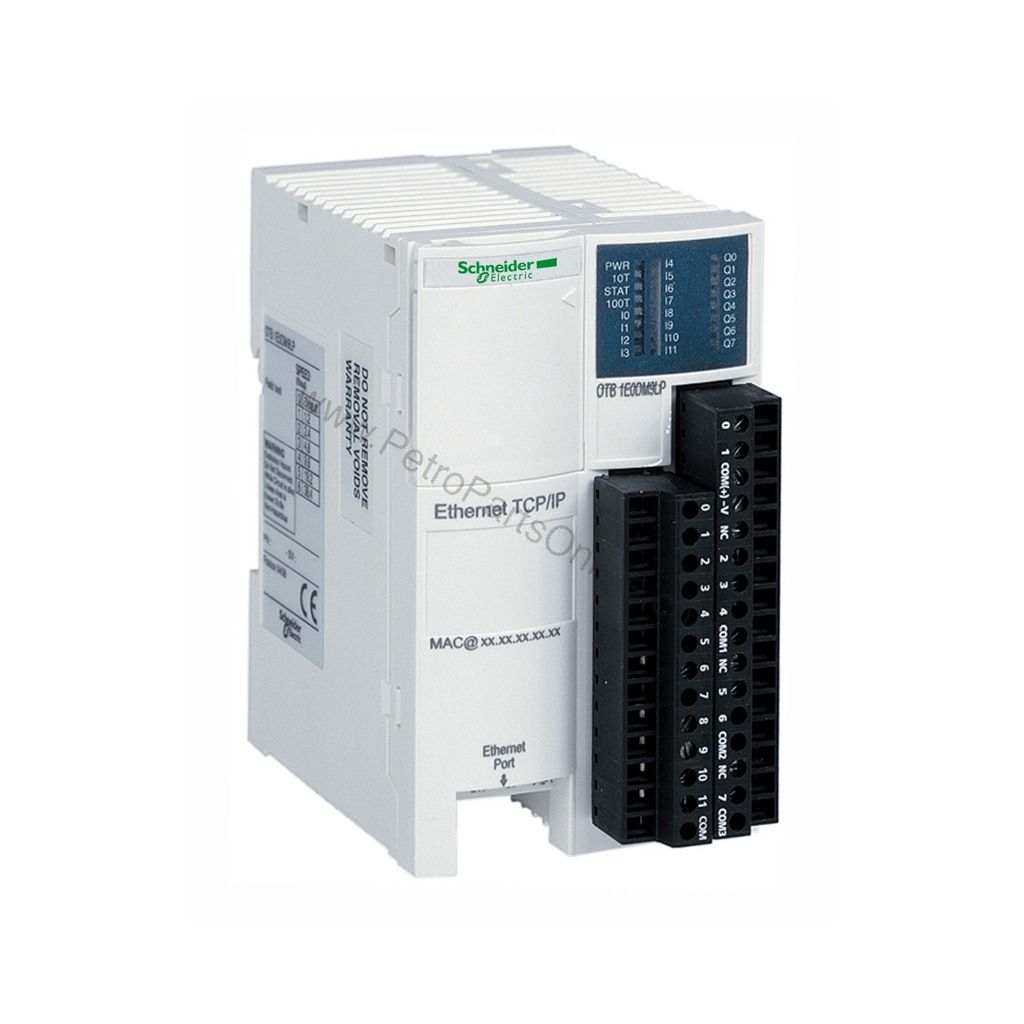
OTB1E0DM9LP | Schneider Electric Advantys OTB I/O Module
Introduction:
Schneider Electric OTB1E0DM9LP Advantys OTB distributed I/O module with 20 I/O, Ethernet Modbus TCP, and 0–55°C range for rugged oil & gas control.
 Customer Reviews
UBEST Automation – Trusted Global Automation Parts Supplier
We offer a wide range of in-stock industrial automation spare parts. All products come with a 12-month warranty and a 30-day refund for quality issues.
Product Attributes:
Notice: For real-time prices and inventory, please click the button below to contact us.
Field-Proven Distributed I/O for Demanding Oil & Gas Control Systems
When a remote wellhead panel or pipeline valve station loses I/O integrity, production and safety both suffer. The Schneider Electric OTB1E0DM9LP from the Advantys OTB series is a rugged, dependable distributed I/O slave designed to keep mission-critical signals flowing over Ethernet. As a bus coupler—not a programmable controller—it integrates seamlessly into existing control architectures, delivering 20 onboard I/O points with the reliability you can depend on in harsh oil & gas environments.
From a maintenance engineer’s perspective, this module’s value lies in its straightforward diagnostics, wide input voltage tolerance, and stable operation across temperature extremes. Whether you are maintaining legacy Advantys OTB installations or sourcing spares for critical operations, understanding its electrical and environmental envelope is essential for uptime.
Key Features and Technical Specifications
- Device type: Bus coupler / distributed I/O slave (not a programmable controller).
- Digital inputs: 12 × 24 Vdc, sink/source, Type 1 per IEC 61131-2.
- Digital outputs: 8 total—2 solid-state PNP 0.3 A plus 6 relay 2 A.
- High-speed counters: 2 × 20 kHz for fast pulse counting.
- Pulse outputs: 2 × 7 kHz pulse generator for simple motion tasks.
- Expansion: Up to 7 TM2 expansion modules for scalable I/O.
- Ethernet port: 1× RJ45, 10/100 Mbit/s.
- Protocols: Modbus TCP, Ethernet TCP/IP, web server, Transparent Ready Class A10.
- Supply voltage: 24 V DC (20.4–26.4 V).
- Power consumption: 19 W; bus current 700 mA at 26.2 V.
- Operating temperature: 0 to +55 °C; storage -25 to +70 °C.
- Relative humidity: 10–95% non-condensing.
- Protection rating: IP20.
- Dimensions (H×W×D): 90 × 55 × 70 mm; weight 0.195 kg.
- Analog I/O: None.
- Lifecycle: Discontinued; replacement TM3BCEIP + TM3 distributed I/O.
The 24 V DC input voltage window (20.4–26.4 V) is particularly valuable in oil & gas facilities where supply rails can sag under heavy load. The module tolerates these variations without resetting, while the 19 W power consumption keeps cabinet heat gain predictable. The 0 to +55 °C operating temperature range covers most sheltered and climate-controlled enclosures, though field engineers should verify local ambient conditions near heat tracing or process lines.
Applications and Use Cases in Oil & Gas
The OTB1E0DM9LP excels in distributed control architectures where discrete signals must be gathered from remote assets. Typical applications include wellhead control panels, pipeline block valve monitoring, tank farm level switches, and compressor station auxiliary contacts. Its 12 digital inputs readily interface with limit switches, pressure switches, and pushbuttons, while the mixed output set—two solid-state PNP for fast DC loads and six relays for higher-current AC or DC circuits—provides application-specific selection guidance for varied field devices.
In a failure mode analysis context, the relay outputs are often the first wear point; specifying them only for moderate switching duty extends module service life. The high-speed counters (2 × 20 kHz) suit flow meter pulse inputs, and the pulse outputs can drive small dosing pumps or indicators. Because the module communicates over Modbus TCP, it integrates with SCADA and DCS systems without proprietary gateways, simplifying both new installations and retrofit projects.
Installation and Setup Guidance
Mount the module on a standard DIN rail within an IP20-rated enclosure—the module itself is not suitable for direct exposure to washdown or corrosive atmospheres. Connect the 24 V DC supply observing polarity and verify voltage at the terminals under load; a reading below 20.4 V indicates an undersized supply or excessive cable drop. The Ethernet RJ45 port accepts standard shielded twisted-pair cable; for oil & gas environments, use industrial-grade cabling with proper grounding to minimize EMI from variable frequency drives and other noise sources.
When adding TM2 expansion modules, power down before connecting and ensure the bus current budget (700 mA at 26.2 V) is not exceeded. The built-in web server provides a convenient commissioning aid—access it via a browser to verify I/O status and network settings. For networks employing PROFINET, EtherNet/IP, or other fieldbuses, note that this NIM variant is configured for EtherNet/IP and Modbus TCP; wiring into such networks may require an external gateway or connection module. Confirm cables and gateways with the supplier before commissioning.
Maintenance and Reliability Best Practices
From a maintenance engineer’s viewpoint, planned inspections are the key to avoiding unplanned downtime. Establish a quarterly routine that includes checking terminal tightness, verifying supply voltage within the 20.4–26.4 V window, and inspecting for dust accumulation that could impede heat dissipation. Relay outputs are electromechanical wear items; log switching cycles and replace the module or external interposing relays before contact resistance rises. The solid-state PNP outputs are more durable but should be protected against short circuits with appropriate fusing.
Environmental factors matter: although the module is rated for 0 to +55 °C, mounting it near heat sources or in poorly ventilated cabinets can push internal temperatures beyond limits. Use the web server diagnostics to monitor module health and review event logs after any process upset. Because the OTB1E0DM9LP is now discontinued, maintaining a spare unit on the shelf is a cost-effective hedge against failure—replacement with the TM3 platform requires re-engineering and downtime, so stocking a field-proven spare protects production.
Compatibility and Integration Notes
The OTB1E0DM9LP integrates with Schneider Electric PLCs and third-party controllers supporting Modbus TCP. Its Transparent Ready Class A10 classification means it can be managed alongside other Ethernet devices in a plant network. For legacy systems migrating from serial fieldbuses, the Ethernet interface reduces wiring complexity and enables remote diagnostics. As noted, this NIM variant supports EtherNet/IP and Modbus TCP; other protocols would require a different NIM or external gateway. Always confirm firmware compatibility with your control system before deployment.
Frequently Asked Questions
Q: What are the power supply requirements for the OTB1E0DM9LP?
A: The module operates on 24 V DC (20.4–26.4 V) with 19 W power consumption and draws 700 mA at 26.2 V on the supply circuit. Ensure your power supply is sized for these demands and stable within the input voltage window to avoid nuisance trips in mission-critical oil & gas applications.
Q: Can the OTB1E0DM9LP operate in high-temperature oil & gas environments?
A: Yes, within its rated 0 to +55 °C operating temperature range. For installations near process heat or in enclosures, verify actual ambient conditions and provide adequate ventilation or cooling. Storage temperature is -25 to +70 °C.
Q: What communication protocols does this module support?
A: The OTB1E0DM9LP provides one Ethernet RJ45 port (10/100 Mbit/s) supporting Modbus TCP, Ethernet TCP/IP, a web server, and Transparent Ready Class A10. This NIM variant is configured for EtherNet/IP and Modbus TCP, with no further communication expansion.
Q: Is the OTB1E0DM9LP still available, and what is the replacement path?
A: Schneider Electric lists this model as discontinued. The recommended replacement is the TM3BCEIP bus coupler with TM3 distributed I/O modules. Contact PetroPartsOnline for availability of remaining stock or migration guidance.
Q: How many expansion modules can be connected?
A: Up to 7 TM2 expansion modules can be added to the OTB1E0DM9LP, allowing I/O count to scale with application needs while maintaining the same Ethernet interface.
Product Support and Availability
PetroPartsOnline maintains inventory of the Schneider Electric OTB1E0DM9LP and related Advantys OTB components for critical operations. In stock and ready to ship, these modules are sourced to support both urgent repairs and planned maintenance. Contact PetroPartsOnline for parts suited to your application’s requirements, including application-specific selection guidance for replacement or spares planning.